Why do government agencies have the reputation – and sometimes the self-image – of being hidebound, uncreative and ineffective. Does it have to be that way? And why do governments seeking “innovation” seem sometimes to be gullible marks for slick salespeople?
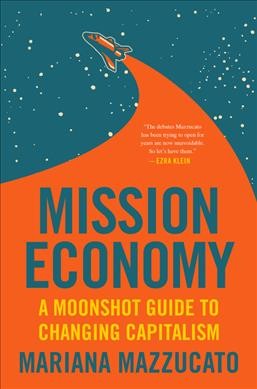
Over the quiet holiday week I read The Mission Economy (2021) and The Entrepreneurial State (2015) by Mariana Mazzucato, providing powerful evidence that it doesn’t have to be this way – and that the world’s urgent challenges call for a different approach with a public sector vision leading the way.
Entrepreneurial State uses the case study of Apple Computer to roundly debunk the myth that the primary engine of innovation in society comes from private sector companies funded by bold, risk-taking venture capital investors. Instead, the book painstakingly investigates the fundamental innovations that Apple packaged – GPS navigation, miniaturized storage, touch screens, voice recognition and more – all came from government-led space and military programs. The government invested in the innovations when short-term oriented investment firms shied away.
Once the core technologies were developed, Apple did a masterful job of elegantly packaging and commissioning the manufacturing of these core technologies into beautiful and useful consumer products that brought enjoyment and utility to everyday life.
In information technology, biotech, and clean energy, visionary government-led programs catalyzed cascades of innovation. Meanwhile, right-wing pundits lambaste occasional failures (Solyndra) and overlooked the dramatic successes such as Tesla and strong overall success rate. And meanwhile, Apple and other tech and pharma companies masterfully took advantage of all of the loopholes to shield the profits that owed much to public investments.
In The Mission Economy, Mazzucato uses a detailed case study of the US Apollo moonshot to explore a model for government initiatives that take on difficult societal challenges – especially climate change.
Mazzucato makes a strong case that the argument that government is inherently likely to be less competent than private business and should only step in the case of a market failure is ideology not destiny, and makes a compelling, evidence-based argument that it is possible to do things differently.
Hallmarks of the moonshot model include:
Setting inspirational shared goals
Shaping the market and private sector partnerships to public goal
Building skilled organizations that learn and takes risks
Budgeting based on outcomes
Mazzucato clearly shows that public sector programs can be led in ways that value learning and risk-taking. The ideologies and trends toward privatization and outsourcing in the 80s and 90s left governments without the skills to manage a mission, lacking in confidence about government abilities compared to the private sector.
The case studies delve into the strategies for procurement and contracting that led to innovative results that achieved the goals of the mission. This requires maintaining and increasing skill on the public sector side of the contract to be able to manage portfolios of projects.
Before you jump and critique the use of the Apollo Moonshot as a case study – saying Gil Scott Heron was right (and I agree) Mazzucato does cite the contemporaneous critics of the space program who questioned why the US was prioritizing the space race when people were struggling with poverty and oppression back on earth.
Mazzucato makes the case that a state shouldn’t have to choose – resources can and should be brought to bear on different challenges at the same time. She acknowledges that challenges of issues such as poverty, health, and education have social complexities that are fundamentally different from the largely technical challenges of the moonshot.
But she definitely underestimates the political challenges of building a shared vision for moonshot missions regarding contested issues. She calls for “dynamic citizen engagement” to take on social challenges, but does not delve into the risks of participation strategies that turn out privileged residents to forcefully advocate for, say, more car parking and less housing. .
And there are risks – and distractions – in the shared sense of purpose that animated the Apollo program. The Apollo program was fundamentally embedded in the cold war – an effort to win the Sputnik race and outstrip the Soviets in space technology. It was an effort to unify the country around the moon mission – rather than on the problems of health care, poverty, and racism that Gil Scott Heron raised – where the country was deeply divided.
Worse than that, at the time when GSH was calling out the problems of decaying housing for Black people in cities, the country was simultaneously actively and successfully pursuing a “moonshot” goal of suburbanization – providing white people new houses with government-supported mortgages, accessible using new highways, while keeping Black people in segregated neighborhoods without funding for maintenance.
Mazzucato acknowledges that social challenges require deep engagement with the public and stakeholders, to reflect the needs of constituents, and to build political support and political will. But she spends a larger proportion of the book covering the technocratic solutions whereby government can effectively manage large, inspiring, mission-driving programs, and can shape markets to drive the public sector to support these mission-based programs.
Mazzucato acknowledges that the bad and false ideas that hobble the potential power of government to lead missions are ideologically driven. But she handwaves through the challenge that the bad ideas are ideologically driven with powerful opponents. This year, the US climate policy may run aground, halted by a senator whose economic base is the coal industry. And the EU’s climate policy may be diluted by the powerful natural gas industry.
Overall, Mazzucato makes a persuasive case for powerful public sector led missions to take on big, existential challenges including climate change, with rich examples of the practices needed to do so successfully.
I’m still reading Mazzucato’s The Value of Everything (2018) which is about how economics since the 1970s has narrowed its focus on GDP growth and prioritized financial returns to shareholders over growth in the economy of goods and services and returns to multiple stakeholders. And I also have Doughnut Economics in the queue, which is a book on the economic model that seeks to replace the one-dimensional goal of GDP growth with a model that works within fundamental limits of environmental and social sustainability.
“Redesigning the American Dream” starts with a case study of a shipbuilding “company town” rapidly assembled during WW2 for “Rosie the Riveter” with 24-hour childcare centers and take-out food service on a straight line connecting homes and ship-building sites.
Vanport City, Oregon housed about 40,000 people at its peak, offered affordable housing for a variety of household types, and was racially integrated with 40% African-American residents. Reading the case study, I couldn’t tell if it was real or science fiction.
Part of Vanport City was dismantled after the war – the town was built under the federal Lanham Act which allowed publicly subsidized housing for the wartime emergency under the condition that the program would be temporary.
Dolores Hayden’s Redesigning the American Dream analyzes housing and land use from the perspective of women and gender roles. The book concludes that single-family detached houses (which accounted for 60% of homes when the book’s second edition was published in 2002) “encode Victorian stereotypes about a woman’s place, while single-family neighborhoods sustain the separation of the household from the world of jobs & public life. Together, houses and neighborhoods form an architecture of gender unsuited to twenty-first century life.”
Hayden uses an analytical framework with three types of housing, the “haven”, US-style suburban detached houses, the “industrial” strategy of large apartment blocks, and the a “neighborhood” strategy with medium-density housing and common space.
Catharine Beecher (sister of the abolitionist) designed prototype suburban houses in the 1840s, designed to create a haven where women would nurture children and men, far from the harsh competitive arena of urban workplaces.
Hayden shows how separation of home and work was reinforced by later policy decisions. After WW1, the labor “family wage” campaign was intended to help returning veterans displace women who had entered the workforce during the war, by providing men enough money for their wives to return home (p.49). At the time business and labor leaders agreed on a strategy to promote suburban home ownership, in the interest of contented workers with economic stability, wives to manage the home, consumption to drive the economy (p.50).
A seemingly opposite model was promoted and took hold in state socialist economies in the 20th century. August Bebel, a German Marxist, advocated in favor of industrializing household work: cooking, laundry, childcare; freeing women to work in factories; people would live in large apartments with dining halls and childcare centers When the Soviet Union put some of these ideas into practice, childcare was provided and 90% of women were in the paid workforce, but housing had neither Bebel’s imagined industrial-scale services nor American-style appliances, so women still worked 17 hours per week more than men. (p. 89)
A third alternative was provided by the “material feminist” movement with leaders including Melusina Pierce and Charlotte Perkins Gilman. Material feminists advocated for daycare, public kitchens, and communal dining spaces that would enable women to be active participants in public life (p. 44)
The material feminist movement promoted ideas of smaller-scale neighborhood designs which incorporated courtyards and public space, ideas which influenced “Garden City” movement planners and designers (173/4). In the United States, this third stream of neighborhood organization created a variety of small-scale developments following these principles, but never grew to become mainstream.
The dominant model in the United States remains the standalone, single-family dream house, surrounded by private landscaping. Though seemingly opposite to Soviet apartment blocks, the outcome for women is similar. “in both cultures (US and Soviet), the majority of married women had 2 jobs, worked 17-21 hours per week more than men and earned about 60-75% of what men earned” (p. 105)
The American Dream House, argues Hayden, “carried unacknowledged costs: they wasted available land; they required large amounts of energy consumption; and they demanded a great deal of unpaid female labor.”
Dream home havens and stressful commutes
Gender role ideas of “separate spheres” contributed to spatial land use patterns separating homes from workplaces, contributing to the difficult childcare commutes experienced by everyone especially working parents (128). But the cause of the resulting stress isn’t always recognized. Hayden writes: Americans often say “There aren’t enough hours in the day” rather than “I’m frantic because the distance between my home and my workplace is too great. (p. 57).. we think of our miseries as being caused by personal problems rather than social problems.
Hayden connects the dots – she cites economist Ann Markusen showing back in 1980 that trends toward gentrification and revival of small cities were influenced by two-earner households choosing locations requiring less travel time.
Nowadays, it is recognized that the separation of homes, services and workplaces not only wastes time and land, it is even more harmful to the environment than recognized when Hayden was writing – will awareness of climate change will help to repair the damage.
Solutions – more land use flexibility, services and public space
By 2000 when Hayden was writing the second edition, it was clear that the stock of standalone houses was not a good fit for contemporary needs, with growing housing affordability challenges, and a mismatch between housing types and changing household structures.
As remedies, Hayden supports more flexibility to modify suburban houses and neighborhoods for different needs, household types, stages of life. She cites large older houses turned into apartments for younger people, and assisted living facilities for frail elderly residents.
This line of thinking has started to make progress since Hayden wrote the book, with liberalization of policies regarding second units in various cities. But reversing single-family zoning is still cutting edge, Minneapolis being the first major zoned city to re-legalize duplexes and triplexes citywide.
Hayden also brings examples of the book has interesting and examples of programs in Switzerland to carve out new common space by sharing formerly private back yards (p.207).
In line with the philosophy expressed in Stewart Brand’s “How Buildings Learn”….since learning is good, overly restrictive rules against change make buildings, places, and communities less intelligent at keeping up with the times. It’s better allow buildings and places to learn.
In excavating the poorly remembered work of material feminists in creating alternative visions and models of housing and domestic services, and the successful examples of women and family-friendly policies and public space in European social democracies, Hayden provides welcome models for re-envisioning and transforming home, place, and service design in the US to be more friendly for women, families, and diversity in households and identities.
And, in remembering the work of innovators whose ideas did not become mainstream, Hayden provides a good reminder that the models we’re familiar with are not the only possible options. Hayden leaves unanswered questions about why some of these models did not grow at the time, and what changes might it take to revive some of the models in the future.
Relative weaknesses and questions: affordable housing, race and class, car-dependence, causality
Hayden supports public and nonprofit affordable housing, but spends much less space on these strategies for housing affordability. These strategies were less politically popular in the Reagan/Bush/Clinton era when the book was written and revised. If Hayden was asked today, I wonder if she would be more vocally supportive of affordable housing.
Hayden acknowledges and routinely opposes racial and economic segregation, but her writing seems oriented toward middle class and affluent readers, and doesn’t always call out racial privilege. For example, in supporting the subdivision of standalone suburban houses, she references younger adults who might want a home carved out of their parents large house; appearing to take for granted a social model where wealth is passed down and harder to accumulate for people whose parents did not benefit from postwar access to home loans and to housing in the suburbs.
Similarly, Hayden attributes the preferences of upwardly mobile buyers for “things we didn’t have” growing up, such as “a large backyard, a gas-fired barbecue, swings and slides.” and assesses that “things we didn’t have” is also a euphemism for a private life without urban problems such as unemployment, poverty, hunger, racial prejudice, pollution, or violent crime.” (P. 34) Racial prejudice is arguably in the wrong place in this list. The reasons for poverty, pollution, and crime in cities traces back to racism and the creation of ghettos.
The analysis in the book somewhat underplays the role racism and car-centric policies, and focuses on more on the motives of commercial developers in creating sprawl subdivisions. Several times in the book she mentions that developers want to build greenfill developments and do not want to build infill developments. This assessment is true for the time, but it underplays a raft of policies that hampered financing of infill development (redlining halted commercial loans not just individual mortgages), and that encouraged low-density car-dependent development with policies considering auto delay as a valid reason to downsize proposed infill projects.
Hayden seems to take these policies for favoring greenfield development for granted. For example, she writes sympathetically about the urban design movement that took hold in the 90s, favoring a return to mixed-use, walkable neighborhoods. “No one would fault these ideas [of New Urbanism]… though the goals were hard to achieve for designers working for developers in car-dependent suburbs where “traditional” zoning and traffic engineering rules prevailed.” (p. 186) The “traditions” that Hayden cities were several decades old at the time of the book’s initial publication, with origins identifiable at the time, some within living memory.
Hayden attributes the preference for sprawl and the reluctance to build infill to the preferences of developers. For example “While greenfield is favored by developers, infill is more practical.” “The American spatial patterns of deteriorated ghettos, skyscraper congestion, and low-density dream houses are inextricably related to land speculation and depreciation.”
It is true that the real estate development and sale industries were largely supportive and encouraging of the segregationist policies that excluded black and brown people from suburban postwar developments, and that replaced explicit racial segregation with zoning-based economic segregation once racial segregation was outlawed by the courts.
But the there are intertwined relationships between the commercial motives of developers who thought that black residents would diminish the value of buildings, the prejudiced motives of white homebuyers who wanted to live in exclusive neighborhoods, and the support of politicians and administrators happy to increase and entrench segregation.
William Levitt, the builder of the archetypical postwar tract suburban housing developments, claimed that his houses were sold only to white people not because he felt any prejudice, but because he was following his customers preferences and contemporary policies. (p. 23). Levitt was an active party to segregation, in a system that included developers, customers, and policymakers.
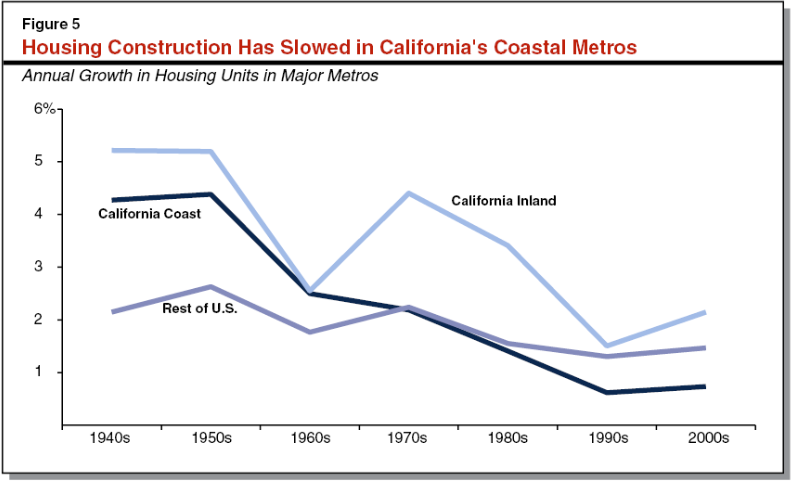
Similarly subject to question is the concern correlating housing affordability problems with “unchecked development.” While at UCLA (if I’m understanding the timing in her bio correctly), Hayden founded a Los Angeles-based non-profit arts and humanities group called The Power of Place which was active from 1984 to 1991. Coastal California has underbuilt housing compared to population growth since the 1970s, a trend which has resulted in the nation’s highest housing prices. If California had been building housing in proportion to population growth when Hayden was there, the housing built in the 80s would be more affordable by now.
The Color of Lawvery clearly lays out the racist motives of policies that entrenched segregation went further than the motives commercial gain. There are additional sources I haven’t read that explore the the relationship of developer-influenced policy on patterns of disinvestment and re-investment, and the relative role this business interest dynamic plays in housing affordability.
The broader question – economics of women’s labor
The issues that Hayden raises, but I don’t think have been well addressed to the best of my amateur knowledge, are broader questions of the role of women’s work in the economy. Hayden notes that in 1920 when it was chartered, the National Bureau of Economic Research made a fateful decision to exclude women’s household labor from economic statistics (p. 125). This absence obscures understanding of the roles women play in the economy and society. For example, when women’s participation in the paid labor increases, the GDP appears to increase, even though there is a corresponding decrease in other unpaid work that women are not doing during the time they are earning wages.
European social democracies have done a much better job with policies around family leave and daycare allowing women to participate in the labor force and public life, but fundamental questions about household labor remain as blind spots in the self-understanding of modern societies.
Summary – recommended reading
While there are stronger books on the broader range of causes of suburban development patterns (Crabgrass Frontier, Dead End, Color of Law), Hayden does an excellent job in tracing the sources of suburban sprawl in ideas about women and gender roles that were enforced in building and neighborhood design, and uncovering models of more egalitarian and woman-friendly living that have been relatively poorly remembered in history. I strongly recommend the book.
I recently read two books – Weapons of Math Destruction by Cathy O’Neil and Algorithms of Oppression by Safiya Umoja Noble – that explore how algorithms in commercial software hide harmful biases. The information provided by “machine learning” algorithms is influenced by biases in the training data they’ve used to learn to classify, and the source data they’re drawing upon.
Software and service providers have a hard time perceiving the biases in their products because of severe lack of diversity in the employee base; lack of skills in humanities and ethics to identify the impacts of biases; and advertising business models are motivated on serving eyeballs to advertisers, rather than providing information to customers.
The biases are concealed in proprietary “black box” algorithms; consumers and citizens aren’t able to investigate the rules and the training data that lead to biased outcomes. The biases in the algorithms are the more pernicious because ordinary people, including professionals, tend to place misplaced faith in output of computers as “scientific” and fact-based.
Weapons of Math Destruction covers a broad range of systems implementing services ranging from credit scoring and insurance, to job applications and college admissions, to criminal justice; along with advertising and information.
In the olden days of non-automated lending discrimination, for example, bank managers would directly weed out black and brown applicants. Now, an algorithm might factor in the economic stability of the neighbors and relatives of an applicant, holding back creditworthy individuals who, like many in communities of color, live in poorer neighborhoods and came from low-income families.
Algorithms of Oppression focuses most strongly on advertising based algorithms, and Google search in particular; and uses a black feminist lens focusing on harms to women of color, as well as other historically marginalized communities. Representations are systematically biased. One of many examples in the book is this Google image search which shows white men as images of doctors.
Another is the experience of an African-American hair salon owner who finds Yelp to be even less helpful than a typical small business owner. Removing images from the Yelp profile took away a marketing advantage that clearly showed a Black-owned business. The salon-owner reported that her customers hesitated to use a “check-in” feature due to culturally justified skepticism of features that could be used for surveillance.
The risks covered in the books are important issues for 21st century civic life and policy, and I recommend both to non-experts. Algorithms of Oppression was somewhat frustrating; its important ideas would be better communicated with the assistance of a culturally-informed editor. The author consistently uses the term “neoliberal” with more and less precision; including in references to classical 18th century old liberalism. The author treats history in very broad and sometimes misleading generalities. For example, she refers to the “public-interest journalism environment prior to the 1990s”, without nod to, for example, the racialized narratives of crime that shaped mass-market journalism from the very beginning.
The remedies that the books outline are suggestive, at the very beginning of initiatives to increase accountability and provide alternatives. Weapons of Math Destruction starts with recommendations for codes of professional ethics among designers of algorithmic models and machine learning systems. WMD recommends regular auditing among algorithmic systems, with academic support and regulatory requirements, including access to the public.
Algorithms of Oppression is more skeptical of a model based on regulation of private sector services, finding commercial motives to be irredeemably untrustworthy. Noble proposes publicly funded search systems that would be free from advertising business model bias and would provide more contextualized information designed to address the needs of communities, including traditionally oppressed communities.
A world where the public sector supports information discovery systems that provide the ease of use of commercial software is far from today’s environment where public sector tools tend to be unsophisticated and clunky; and where public funding is exploited by contractors whose core competency is billing public agencies.. Providing search services that are scalable to vast amounts of information; can be used by billions of ordinary people, unlike the pre-google tools used by a small number of expert professionals; and can provide contextualized information is a very difficult thing to do.
The focus on information serving communities rather than individuals has substantial risks the book doesn’t cover. Information services that serve religiously conservative communities can be customized to conceal information about religious diversity, LGBTQ information, evolution, and so on. Mainstream US residents would agree that the top search results for “black girls” shouldn’t be porn (which the author discovered with Google search in 2012 and had been largely fixed by 2016); but a religious community might also object to images that show exposed hair or naked elbows. Decisions about what information should be shown and suppressed in a culturally sensitive manner are more complicated and fraught than the book addresses.
Also, public search systems may not be a panacea in a world where government information systems carry differently terrible risks of surveillance and political oppression; consider China’s social credit system.
These books are just starting to scratch the surface in critiquing algorithmically biased systems, and in proposing remedies. These are important issues, and it’s good time to engage in critique and start to consider solutions.
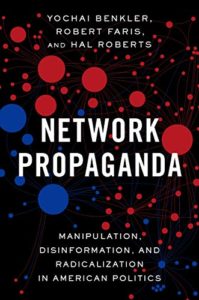
A new book with rigorous analysis of how millions of stories were published, linked and shared over the last three years yields some surprising findings and valuable insights into dangerous trends that are posing risks to American democracy.
In Network Propaganda, Yochai Benkler, Robert Faris and Hal Roberts at Harvard’s Berkman Center used a variety of analysis tools to track the links and sharing of over 4 million pieces of content during and after the 2016 US presidential election. They find – to their surprise – that while social media serves as a vector for the spread of false and pernicious stories, and bad actors including state-sponsored Russian trolls and commercially motivated clickbait farms contributed to the fog of misinformation, it turns out that to date, these haven’t been the main agents contributing to the proliferation of of untruth.
Mainstream media with fact-based journalistic norms are still by far the most powerful voices; and are able to reach a substantial majority of the population. So important solutions to the spread of misinformation lie in the practices of mainstream journalism.
The custom of bringing voices from “both sides” should be deemphasized when one side of the discussion is further from verification, for example quoting vaccination opponents and climate deniers for “balance” Instead, reputable journalists should place greater emphasis on objectivity by showing verification.
The authors do find evidence of a “filter bubble”, but the phenomenon is asymmetrical, concentrated on the far right of the political spectrum, where people tend to rely exclusively on right-wing media and not on other media with stronger orientation toward facts. “The right side of the spectrum… has Breitbart and Fox News as its basin of attraction, has almost no overlap with the center, and is sharply separated from the rest of the map.” There are also conspiracy theories and other false stories that come from the left side of the spectrum, but the stories tend not to spread as far because misinformation gets fact-checked by other publications.
And the filter bubble on the right isn’t new, and it wasn’t created by Facebook or YouTube or Russian internet trolls. The book traces how the right wing filter bubble goes back decades, to the rise of televangelism, Rush Limbaugh, and right wing media ecosystem that prides itself in denouncing mainstream media, science and academia. This set of circumstances is distinctive to the US media ecosystem, not generalized in other parts of the world.
Benkler et al don’t discount the risks of social media sharing of disinformation, and have some policy recommendations to add to that important discussion and debate. But based on the analysis in the book, it’s not – yet – the main problem threatening democratic discourse in the US.
Because its conclusions rely on robust analysis of lots of data, I strongly recommend Network Propaganda to anyone concerned about the risks of today’s media environment to democratic discourse.
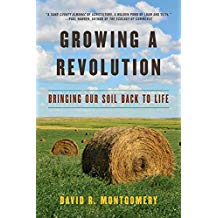
Growing a Revolution was inspiring Thanksgiving holiday reading. Written by MacArthur Fellowship recipient David Montgomery of the University of Washington, the book reports on global examples of farmers adopting practices of “conservation agriculture” which restore soil as a renewable resource, instead of degrading soil over time.
By avoiding plowing, using cover crops, and employing crop rotation, farmers are able to use much lower levels of fertilizers, pesticides and fuel and make higher profits, with less vulnerability to drought and storms. These practices result in less polluting runoff, better habitat for biodiversity, and – not least – store increasing amounts of carbon in the soil.
The book explains how relatively recent scientific progress in soil ecology and microbiology has provided greater understanding of the systems that build up productive soil – plants have symbiotic relationships whereby they feed sugars to fungi that deliver nutrients to plants and emit proteins that hold soil together; the fungi have symbiotic relationships with bacteria that metabolize nitrogen, phosphorus, and other minerals. Earthworms, termites, ants, other invertebrates and their micro-symbionts help digest compost, recycle nutrients and structure soils to retain water.
This mutualistic ecosystem is much more complex than simplistic equations that calculate the amount of fertilizer and water inputs needed to grow plants for harvest. Input-based agriculture can deliver high crop yields in the short term, but degrades the soil leading to lower productivity over time.
The practice of plowing breaks the connections between plants and the fungi that feed them; plants well-fed with synthetic fertilizers don’t provide nutrition to symbionts; and pesticides also kill the beneficial organisms that enable soils to hold moisture. So dry soils and extra fertilizers are washed away by irrigation and rainstorms. Fields that are plowed and treated with fertilizers and pesticides gradually lose soil, require even more fertilizer, are more vulnerable to drought and storms, and shed carbon into the atmosphere.
Healthy soil practices are extremely promising for climate protection. Scientific estimates differ, but it is clear that the broad use of agricultural practices that restore soil carbon instead of mining it could go a long way toward pulling carbon out of the atmosphere. And the book shows how farmers adopting healthy soil practices can start regenerating soil and improving farm economics within a few years – potentially leading to relatively rapid carbon drawdown.
The focus of “conservation agriculture” on building up soil health is different from the focus of “organic agriculture” on refraining from all synthetic fertilizers and pesticides. Farms can practice conservation agriculture, use much lower levels of pesticides and fertilizers, and increase soil carbon, but still not qualify as organic. By contrast, a farm could be certified “organic”, but use frequent plowing that breaks up soil ecosystem, and use monoculture practices that depend on “organic fertilizers”, while still eroding soil and losing carbon over time.
But “healthy soil” practices aren’t yet visible to consumers. While “organic” has become a mainstream brand allowing consumers to choose foods produced without synthetic pesticides and fertilizers, there isn’t yet a certification system and brand allowing consumers to choose food that was grown with practices that maintain soil and climate health. The book identifies this as a potential opportunity to engage consumer power in promoting healthy soil practices.
The book identifies other institutional barriers hampering broad-scale adoption of conservation agriculture. In the US and many places around the world, agricultural education and farm support programs are largely geared toward promoting high-input monoculture. The major corporate purveyors of fertilizers and pesticides have lobbied for policies and incentives to keep the system of input-dependent monoculture well-entrenched. “Crop insurance” programs help insure farmers against drought and storms, but don’t support “preventive care” investments to help farmers get started with practices that make farms more resilient to drought and storms.
Most of the US-based farmers in the book were in red states, and had conservative, conservationist beliefs as well as economic self-interest motivating their soil health practices. Hopefully there is some combination of rural local politics and “green new deal” climate advocacy that can break the logjam and accelerate the spread of healthy soil practices.
The potential is great. “Growing a Revolution” makes a strong case that practices to reverse long-term soil damage are relatively simple, cost-effective, and transformative for farmers, ecosystems, and climate. With climate change evident in the fires burning California, the stakes couldn’t be higher.
Big Chicken, by science journalist Maryn McKenna starts off with a scientific detective story, tracing how experts at the Center for Disease Control tracked down the connections between outbreaks of antibiotic-resistant bacterial infections and animals that are dosed with large quantities of growth-promoting and preventative antibiotics. The book explores the history of how newly-discovered antibiotics became the foundation of industrial farming, allowing animals to be grown rapidly in very close quarters in large quantities at lower cost. Antibiotics became such a staple of industrial agriculture that farmers have been dosing non-sick animals with quantities of antibiotics larger than are used in all of human medicine.
It was not only the scientific discoveries and the dwindling power of antibiotics to defeat resistant bacteria that led the industry to back away from practice of routine antibiotic use, and the relationship between science, politics, and industry varied widely in different parts of the world. England backed away early, thanks to research in the 50s and 60s – a few key scientists who held leading administrative positions, and had prestige to influence legislation – and a shocking plague of hoof-and-mouth disease that instigated national reflection about meat-raising practices. In France, cultural values of good-tasting food have taken higher priority than low-cost, high-volume production of bland poultry and meat. In the Netherlands, it took til the late 90s and 2000s for the change to take hold; farmers turned toward highly efficient poultry production without routine antibiotics once evidence mounted that farmers themselves had become carriers of antibiotic-resistant infections that they picked up from their animals.
But in the United States, the poultry and meat industries pushed back hard, using sophisticated and well-funded PR and lobbying tactics of denialism familiar from the tobacco industry’s pushback against evidence of the health hazards of smoking and the fossil fuel industries’ pushback against evidence of the environmental disaster of climate change. Big Chicken does a good job of explaining the tight control that a small number of poultry producers hold over farmers, who raise strains of animals provided to them, using feed mixes provided to them, using finances provided to them. in an industrialized version of the traditional sharecropping system. The meat industry successfully staved off regulation for decades until executive orders from the Obama administration which have taken effect only recently. Unlike many other Obama-era executive orders, the rules protecting against antibiotic resistent bacteria haven’t yet been reversed by the Trump Administration as far as your blogger can tell.
https://obamawhitehouse.archives.gov/the-press-office/2014/09/18/executive-order-combating-antibiotic-resistant-bacteria
According to Big Chicken, what promoted change before legal reform took hold was consumer advocacy. Consumer preference for healthier poultry and meat started with counter-culture practices, and then niche market players like Whole Foods. Driven by a growing upswell of consumer concern about the risks to human health caused by massive antibiotic doses (and other health risks of factory farming), major poultry producer Purdue Chicken and major retailer Chick-fil-A took the lead in reducing antibiotic use and finding other means to profitably raise and distribute chicken without mass doses of antibiotics.
However, Big Chicken touches on the tale of successful consumer advocacy only lightly – there are other stories told elsewhere or yet to be told about the consumer advocacy initiatives that led the industry to start to pivot away from some of the harmful practices of factoring farming. The book does an excellent job of recounting the history of science and technology that led to antibiotic overuse, and provides an interesting cross-cultural analysis of how different parts of the world moved away from antibiotic overuse, including grim and fascinating reporting on the industry structures in the US that, despite the grave risks to human health, kept most growers from changing their practices until recently.
Richard Rothstein’s Color of Law is a devastating summary of the many ways that the US government created a society that was racially segregated by law, and as a consequence profoundly unequal in wealth. The account is powerful history, and needed for people to face segregation and inequality. But I’m not sure the focus on constitutional law is the best fulcrum for change.
The book shows in robust detail how segregated living patterns were shaped by government policies. Public housing in the first half of the 20th century was not only designed to be segregated, it imposed segregation on previously integrated places by replacing integrated neighborhoods with segregated housing projects for white and black people. Federal policies excluded middle-income African Americans from homeownership and wealth-building, through rules requiring segregation in federally-backed mortgages, racial exclusion in the GI bill, and racial covenants enforced by law. Policies deliberately sited highways to destroy African-American neighborhoods, and policies zoned to allow polluting industries and vice businesses in African-American neighborhoods. Policies drew school attendance boundaries to increase segregation and move white and black neighborhoods further from each other. Recently, in the housing bubble and bust in the 2000s, the predatory lending policies that lead to an epidemic of foreclosures and were targeted disproportionately at African-American buyers, and the resulting catastrophic loss of wealth disproportionately impacted African-American families. The litany is solidly researched and conclusive, and reaches into the present.
Rothstein was drawn to create this airtight case by the well-known and dubious logic used by Justice Kennedy ruling against a school integration plan in 1992, and cited by Chief Justice Roberts again ruling against school integration 2007, arguing that the residential racial segregation which drives school segregation is largely voluntary, driven by private choices, and therefore doesn’t require or allow government remedies. Thus Rothstein’s motivation to prove conclusively that segregation has in fact been created by government policy.
The book runs through a brief but scathing summary of leading high school textbooks that replicate the myths of voluntary segregation. Telling the history accurately, including in school education, is essential to changing people’s perspectives and opening people’s minds to the need for different policies.
The proof of dejure segregation is important for public consciousness, but the book’s focus on constitutional problems and federal remedies seems problematic as a primary lever for policy change. The wheels of constitutional law can grind powerfully, but exceedingly slowly most of the time. Cases need to be brought at a local level, and make their way through a decentralized appeals court system. The US Supreme Court chooses which cases it wants to take on, takes only about 1% of cases each year. It can take decades for an issue to surface as a Supreme Court ruling. In areas of school and residential segregation, rulings that don’t have public support can be ground down by ubiquitous workarounds.
While it is true that the segregated living patterns and wealth disparities were definitively created by government policy, there has been a pivot that the book acknowledges but underestimates. The book cites several cases where, governments, stymied by the illegality of segregating by race, turned to economic segregation via zoning. In one of the episodes in saga of failed attempts to build integrated housing near an automotive plant in Milpitas, “when officials discovered that the project would not be segregated, the town adopted a new zoning law increasing the minimum lot size from 6,000 to 8,000 square feet, making the project unfeasible for working-class buyers.”
In Chapter 4, the Color of Law shows how initiatives led by Secretary of Commerce Herbert Hoover in the 20s pioneered guidelines to separate single family from multi-family housing, with an underlying motivation of racial as well as economic segregation. During the Great Depression and WW2, home construction ground to a halt, but zoning rules blossomed in influence with the 50s post-war construction boom of single family, single-use zoned subdivisions.
Looking for levers to change policy today, it seems much more direct to focus on economic segregation enabled by zoning, which is currently legal; and to highlight the deep cognitive dissonance whereby people who decry economic inequality also support continued separation between apartments (or for that matter duplexes and triplexes) and detached houses. “Protect single family neighborhoods” is a common mantra and political conventional wisdom, among people who would have a hard time explaining what harms the single family neighborhoods are being protected from.
Another concern about the book’s policy orientation is that Rothstein seems to largely accept the premises of car-centric, single-use, home-ownership-focused suburbanism. Rothstein recounts sympathetically the motivations of middle class people seeking to escape crowded, urban conditions, with less corresponding questioning of the specific causes of tenement crowding.
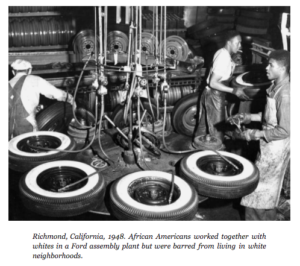
Rothstein accepts the typology of inner city black slums and white suburban refuges in encouraging policies to help poor black families move into suburbs, even as the economic map has changed somewhat with the renewed popularity of walkable urban places. A telling quote is this: “meanwhile nearby schools in white neighborhoods had many empty seats as a growing number of white families left Richmond for the suburbs.” But Richmond, with a boom-and-bust population between 70,000 and 100,000, has never been a dominant city in the Bay Area, and is less dense than the supposedly “suburban” Milpitas to which it was being compared. Rothstein’s use of the terms “urban” and “suburban” seem like euphemisms for “town with many black people” and “town with many white people.”
The book does a brilliant job of showing the force of government-backed segregationism in creating white suburbs, but ignores the parallel forces of government-backed automotive and oil-industry policies in creating car-dominated, low-density, unwalkable places that fostered unhealthy, sedentary lifestyles, paved watersheds and natural habitat, polluted the atmosphere, and are the largest contributors to climate change. As Strong Towns highlights, suburban places accrue superficial and temporary benefits from cheap land, but impose high costs of car-ownership, and high per-resident infrastructure and environmental costs. To ensure convenient access by space-inefficient cars, policies mandate fully subsidized housing for private vehicles, while treating housing for people as optional. Attempting to fix segregation by helping lower-income African-Americans move to car-dominant suburbs has some benefits, but seems to perpetuate problems and create some new ones.
In a postscript, Rothstein briefly touches on the reverse problem of gentrification and displacement, as people with means return to walkable urban areas. Rothstein writes, “Gentrification would be a positive development if it were combined with inclusionary zoning policies to preserve affordable housing in every neighborhood.” But with its primary focus on the segregationist impulses behind suburbanization, the book doesn’t fully grapple with current trends, opportunities and challenges of re-urbanization.
Rothstein writes favorably about the importance of home ownership and home value appreciation for building family wealth, while noting the contradiction between considering the mortgage interest deduction as an entitlement while accepting long waiting lists for Section 8 housing vouchers. But the book does not address the tension between promoting home ownership, depending on home prices increasing, and a housing affordability crises, which is worsened by home prices continually increasing.
One small quibble in sourcing. The book does a good job of primary research, weaving in stories of African-Americans who worked hard, served their country, and still faced discrimination that has held families back for generations. The book would also have benefited from a few more of the voices of African-American advocates for civil rights in housing, who fought losing battles against segregation for many decades. Works by authors including Khalil Gibran Muhammad and Nikole Hannah-Jones do a better job of incorporating the voices of African-American leaders who proposed alternative policies, in addition to the important voices of people who suffered from discriminatory policies.
Overall, the Color of Law provides overwhelming evidence of the role played by policy in creating segregated living patterns and extreme wealth inequality, and should be required reading for anyone interested in US housing policy. However, for policy remedies to the tough problems, I don’t think the book is the last word.
Since the 70s and 80s, artists and other newcomers in search of cheap rent put sweat equity and creativity into restoring and transforming decaying factories and warehouses in Gowanus, the neighborhood surrounding the heavily polluted canal in South Brooklyn. And then many of these same newcomers organized in favor of preserving abandoned buildings, in the interest of protecting the “character” that the formerly bustling industrial hub had accrued by virtue of being largely deserted. This story of the efforts to preserve the appearance of industrial decay is the section I found most interesting about Gowanus, Joseph Alexiou’s history of the neighborhood and canal.
The book wends through the various stages of the neighborhood’s history, starting as a teeming estuary, burgeoning with molloscs, fish and birds, peopled by Lenape native americans; an agricultural hinterland for Colonial New York; the site of momentous revolutionary battles; the subject of decades of speculative endeavors to profit from urban infrastructure in the 1800s; an economically booming, polluted, class-divided industrial powerhouse with factories producing coal gas, chemicals, leather products; warehouses storing and transporting imports and exports, and dense, rundown housing for successive generations of immigrant wage workers through the 50s; a depopulating haven for organized crime families and people in poverty left behind by subsidized white flight to the suburbs; and then the subject of bohemian rebuilding, and competing pressures for redevelopment and preservation.
Across the stages of the area’s history, book tells the story of the fitful and never-successful efforts to build drainage infrastructure for the former estuary once it was paved over, through the latest attempts at drainage and cleanup. The combined stormwater and sewer system, a design that seemed thrifty and ingenious when it was invented, failed miserably, ensuring a future of sewage overflows.
In telling the stories of Gowanus across time to the present, there is a key element that Alexiou leaves out. Recounting the story of the contemporary settlers striving to preserve the area’s “industrial zoning”, he skips over the important story of when and how zoning was introduced to begin with. In the area’s industrial heyday, Gowanus included housing for factory and warehouse workers near the industrial sites where they worked. The workplace conditions and pervasive pollution were hazardous for the laborers health. Residents who restored warehouses as live-work lofts are eager to preserve the area’s distinctive appearance of post-industrial decay, but are not nostalgic for the good old days of coal gas manufacturing plants and tanneries. Industrial zoning was implemented to protect residents, but also contributes to sprawl, long commutes, and the de-industrialization of urban areas. There is a story to be told about what economic functions can be combined with modern standards for safe working and living conditions, but the book doesn’t tell it.
Also, the contemporary preservationists oppose newly proposed housing as “overdevelopment”, while showing a lack of nostalgia for earlier levels of population density in the area’s industrial heyday. Why should they get to turn the clock back to the depopulated state of the neighborhood when they moved in, rather than the density levels of the working class neighborhoods when the factories were churning out products? The reader can empathize with the neighborhood activists who lament the change change that is transforming their gritty, post-industrial paradise. But to cope with the end of an era, it is healthier to hold funerals than to seek to animate zombies.
Moving from substance to style, this book makes me appreciate the challenge of telling a compelling topical history. The genre turns a microscope on its singular subject to illustrate a set of changes across time. Works in this genre are not intended to be a definitive source on the sub-stories they tell along the way; this book isn’t intended to be a comprehensive source on Revolutionary battles, or 18th century industrial finance and financiers, or 19th century working conditions and labor conflicts. Success in the genre depends on readers being delighted by insights into the background and origin of familiar things; but depend on the writer’s judgement – how to tell just enough of each story to provide a dramatic arc, and to illustrate and move forward the themes of the book, and how much of one’s hard-earned research to leave out.
I found Gowanus to fall short in the art of pacing needed to excel in this genre; there were too many specifics about the troop movements of British and American armies, an excess of details regarding the architectural ornamentation and decor of the 19th century financier’s mansion, perhaps a few too many instances of gruesome industrial dismemberments than needed to get across the hazardous working conditions. Lingering on the evidence in each of the book’s episodes, it wasn’t clear which elements of the book’s themes the story was seeking to move forward. I’m glad that I read the book, but found myself occasionally skimming the details. The pacing challenges illustrate the difficulty of creating an work in the genre that is excellent, not just interesting.
My favorite part of How the Bible Became Holy is the story of how the Jewish community of Alexandria, a Greek-speaking diaspora community in the Hellenistic Ptolemaic empire, who were excluded from cultural and civic institutions centered around the study of Homeric literature and greek philosophy, developed synagogues as institutions for worship and study centered around the public reading of Greek translations of the Hebrew bible.
In the intellectual and cultural context where Greek philosophy was studied as a guide for living a good life, the works of the Bible were similarly employed by Alexandrian Jews as the base for homiletic teachings. In this persuasive telling, the revered, central, literary and normative roles of the Bible evolved as a backformation from Hellenistic cultural practices.
Other elements of the book are interesting, but sometimes less persuasive. Michael Satlow, professor of religious studies and Judaic studies at Brown University, traces the evolution of Biblical narratives starting with elements of the Hebrew Bible in 10th century BCE through their roles and canonization in Rabbinic Judaism and institutional Christianity.
In the 10th Century BCE Satlow explains the emergence of shared stories helping to unite a loose Israelite confederation, and fragments of law codes and prophesies and proverbs collected by scribes under the Judahite Kingdom in the 8th to 6th centuries BCE. Satlow make a case that biblical texts did not have a high profile during the biblical period. Literacy was low, and written texts, including components of law codes adapted from other law codes circulating at the time, were scribal exercises written largely for an audience of scribes. But positive evidence is minimal for this or other hypotheses about the origins of material from this period.
Satlow brings forward another set of hypotheses with fragmentary evidence relating to the evolving roles of the bible among the Pharisees and Saducees, feuding Jewish political/social parties and schools of religious thought in the century before the destruction of the Temple in 72CE. Satlow holds to a the scholarly opinion that the small, ascetic religious sect that decamped to desert by the Dead Sea, and left behind a large repository of texts known as the Dead Sea Scrolls, was a Saducee splinter group which fled vicious Hasmonean politics in the 1st Century BCE (other schools of thoughts hold that the Qumran group were Essenes). In a volatile age, the Qumran group sought certainty through the use of revered written texts as the source of oracular prophesies and secret codes, helping to pioneer these uses of biblical texts.
Meanwhile, Pharisees, Satlow argues, emerged from a rural aristocracy relying more on oral traditions than texts. However, because oral traditions weren’t written down, there is minimal evidence, other than the later-written Rabbinic traditions that asserted continuously transmitted oral traditions back to Sinai. Rabbis began reluctantly committing the “oral torah” to writing starting with the Mishnah in the 3rd Century of the Common Era. Satlow observes that the Mishna is surprisingly lacking in scriptural citations, and attributes this to an attitude de-emphasizing scripture; but could it be because the scriptural connections remained part of an oral layer, according to the stories the Rabbis themselves told?
The distinctive Jewish treatment of biblical texts, where the text itself is frozen and revered, while new, strata of creative legal, homiletic, and literary interpretation build on the text, dates to the Talmudic rabbis and their descendants, which Satlow attributes to a convergence of Pharasaic oral tradition and Saducee reverence for text.
The book also explores the roles of the scriptural tradition in emerging Christian Gospel literature. Use of scripture varied by audience, as Christianity spread among Gentiles and Jews; works aimed at Jewish audiences used more scripture than works aimed at Gentile audiences. Christians built on the use of biblical texts as oracles to add a superstructure interpreting previous writings as predicting and foreshadowing the emergence of Jesus as Messiah. Apparently, Christians got around to creating a fixed canon in response to movements to exclude perceived heresy. Readers who are more familiar with the evolving role of scriptures in Christianity will have stronger reactions to these parts of the book.
How the Bible Became Holy provides interesting food for thought about how this set of ancient texts books evolved the various attributes that make them “biblical” – objects that are treated with reverence, that serve as central literary texts that are interpreted on an ongoing basis, and are used as guidance for religious adherents’ lives.
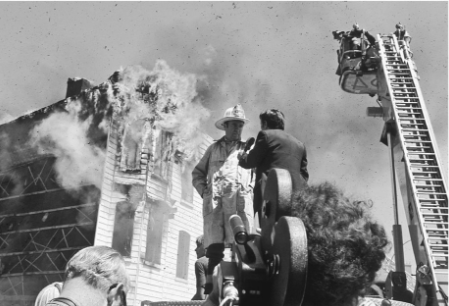
Conventional wisdom holds that the main cause for the New York fires was arson, as landlords responded to catastrophic declines in property values by taking out the nominal value in insurance. Flood shows that arson, at its worst, took only 7% of buildings; and then only after buildings were abandoned; most fires had ordinary causes like cooking and electrical shorts, exacerbated by lack of building maintenance and lack of inspections.
The extreme level of destruction was driven by technical hubris; Mayor Lindsay brought in computer whizzes to rationalize government departments and increase efficiency. But the administration’s blind faith in technology was misplaced. With flawed models and bad data inputs, the computers generated destructive recommendations to shut down fire stations in poor neighborhoods with frequent fires. These recommendations dovetailed nicely with existing prejudices, so city leaders did not second-guess the recommendations to cut service in areas with little political clout.
The book is a fascinating and solid work of history, with detailed and empathetic reporting on the cultures of the firehouse and public fire department; the information technologists who came up through military and corporate bureaucracies; and civic technocrats who sought to apply the technologies. Particularly interesting for those unfamiliar are the innovations in fire-fighting tools and methods that greatly reduced the death and damage from fires. The fire chief who made the calls during the period is portrayed as a tragic figure whose leadership and technical competence was undermined by political ambition and prejudice.
Brooklyn burns, the fire chief who implemented the disastrous technology that crippled firefighting watches
The stories of destruction aren’t portrayed as ruin porn; anecdotes about fires include vignettes and quotes from the largely Puerto Rican and African-American families who were burned out and displaced. And the book also discusses the resilience of people who regrouped and rebuilt after the destruction, and the culture heroes who created hip-hop in the burnt-out ruins of the Bronx.
“Fires” puts the political dynamics of urban firefighting in context of New York’s oscillating competition between local patronage-based ward bosses and reformist technocrats. In recounting a colossal failure of technocracy, the book is sympathetic to the more incremental, practical, small-scale approach of the ward system. But it seems to me that this sympathy underestimates the longstanding, large and complex systems needed to manage water, power, transportation and public health, and the expertise needed to create and maintain these systems.
The book puts decay of New York’s neighborhoods in the context of highway destruction, redlining which made it impossible to fund maintenance in urban areas, deindustrialization, and white flight leaving residents of color in concentrated poverty.
What isn’t clear, with the book’s exclusive focus on New York, is how much urban destruction affected New York distinctively, and how much was common to de-industrializing cities in the same era. The South Bronx experienced devastating destruction; so did North Philadelphia, Baltimore, Detroit, St Louis, and more. Did New York actually burn harder for different reasons?
Flood attributes the deindustrialization of New York to new zoning codes driven by real estate interests eager to repurpose industrial land for new high-end office and residential development. Were these trends similar in other cities or distinctive in some way to New York?
Meanwhile, as the South Bronx and Central Brooklyn burned, largely white middle-class newcomers painstakingly restored dilapidated brownstones in other neighborhoods of Brooklyn. The gentrification story started earlier than one might think, with white collar professionals, artists, and social workers moving out from Manhattan into Brooklyn in the 1950s.
Where Fire draws on journalism and narrative social history with dramatic or telling vignettes sourced with interviews and documents, Brownstone draws on cultural criticism, with the landscape itself described as a “text” using the vocabulary of academic literary theory. Brownstone pays close attention to the cultural perceptions of Brooklyn gentrifiers, and the representation of Brownstone Brooklyn neighborhoods in works of literature, film, and television.
Brownstone Brooklyn analyzes the romantic view of the neighborhoods and neighborhood life held by college-educated white collar migrants. These residents viewed urban neighborhoods as having soulful authenticity, in contrast to the artificial and soul-less experiences of gleaming Manhattan towers on the one hand, and sterile suburban tracts on the other. But these romantic perceptions, along with place names drawn from pre-urban farms, farmers markets and street festivals, were brought into being by the migrants themselves. “Boerum Hill, for example, was a name invented in the 1960s and 1970s to describe an area that had always been flat.”
A fascinating section of the book reviews the school of literature focusing on the working class and demimonde, crafted by writers all living in the same part of gentrifying Brooklyn: Mailer, Capote, Kazin, Selby; all exploring aspects of the gritty realities they perceived in the lives of their working class and poor neighbors. “Novels such as Albert Halper’s Atlantic Avenue and Frank Paley’s Rumble on the Docks shocked readers with their uncompromising depiction of life in the slums.”
The romantic ideals of the “brownstoners” often contrasted with their economic livelihoods. The white-collar professionals, artists, writers, and academics cultivating the “historic” neighborhoods of Brownstone Brooklyn worked in gleaming new corporate headquarters, research universities, medical centers, and media conglomerates of high-rise Manhattan and downtown Brooklyn.
In the name of authenticity, new homeowners in gentrifying neighborhoods would evict rental tenants living in subdivided flats, and restore buildings that had been converted to rooming-houses back to their “authentic nature” as single family homes. The new residents banded together to oppose the expansion of longstanding industrial uses in the neighborhood. Which uses of a building or a block are the most “authentic” are up for debate. The newer property-owners would lovingly restore or recreate the original surfaces and decorations of their homes in the Victorian era, while objecting to the decorations of older working-class residents that newer residents perceived as crass and tasteless.
The book portrays a complex political environment, with where white middle-class liberals tussled with a system with ward bosses, and largely lower-income African-American and Puerto Rican residents. Brownstoners were continually frustrated by working-class residents who looked to old-school ward politicians for the concrete delivery of services through longstanding personal relationships rather than espousing broader social goals and policies.
In the 1970s, a multi-class and interracial coalition of homeowners and landlords battled redlining in the area. But In the name of preserving neighborhoods, liberal middle class Brooklyn residents defended local control of schools, demanding policies that kept middle-class white children apart from lower-income brown and black children; and many opposed public housing in their neighborhoods, with preferences suspiciously hard to distinguish from racist segregationism.
The romantic view of their Brooklyn neighborhoods contributed to relentless fights against urban renewal megaprojects, which were protested even when resubmitted in scaled down form until they were finally killed. This tradition of opposition to massive redevelopments that displaced hundreds or thousands of residents calcified into a custom of opposing even smaller-scale, infill developments that didn’t displace anyone. An ethic favoring historical preservation became an ethic of suppressing most changes, creating a “slow-growth” political movement that crossed class and ethnic lines, that contributed to later housing shortages.
Takeaways
The two books together provide enlightening and cautionary lessons.
The lessons of Fire about the dangers of blind faith in civic technology remain timely today, as new waves of hype about “smart cities” promote black-box algorithms sold by profit-seeking vendors. Our cities remain vulnerable to enthusiastically hyped technologies that civic leaders are encouraged to accept on faith and without corresponding transparency and accountability.
Brownstone Brooklyn’s portrayal of the romantic ideals, self-deceptions, and hypocrisies of middle-class renovators provides enlightening historical context for the origins of today’s urban housing crisis. The romantic ideals of preservationism contributed to diminishing the stock of affordable housing by deconverting flats and preventing the building of new apartments that didn’t meet the ideals of a small-scale village.
American racism and classism is woven through both stories, very clearly in Fire, where the prejudices of policymakers and bureaucrats allowed neighborhoods to burn. These threads are woven through with more nuance in Brownstone Brooklyn, where more affluent, whiter residents evicted lower-income tenants and more downscale industries, but the ebb and flow of neighborhood class and ethnicity mix over time defies facile narratives of gentrification as colonization, and the interests of wealthy homeowners and lower-income neighborhood leaders aligned to fight development in ways that paradoxically accelerated changes they wanted to prevent.