I had a fascinating conversation at EqualityCamp about the status of social media in California politics. Apparently, despite the dramatic upset success of the McNerney campaign, fed by "netroots" small donor fundraising and upstart blog-driven citizen journalism, oppo research and organizing, the political mainstream in California is still fixated on mass media politics. Big-block fundraising is used to fund mass media advertising campaigns with highly controlled messaging created by campaign consultants based on focus group research.
The collossal failure of this model in the NoOn8 has driven those of us who live in a social media, grassroots world absolutely bonkers. But apparently, even the dramatic Obama victory fueled by small-donor fundraising and grass roots, neighbor to neighbor organizing, hasn't done much to change how the California political class thinks about campaigns.
The state of affairs smells like a classic early market, which in Geoff Moore's classic taxonomy, hasn't yet "crossed the chasm". There are classic barriers, and some classic tactics for overcoming the barriers.
Barrier: There is a well established process for funding and running campaigns.
Opportunity: Identify a niche where social media tactics provide an advantage. Marriage equality is clearly in this category, since personal outreach is the best known way to change hearts and minds on the topic. There are likely other niches where a social media strategy can gain a foothold and win success.
Barrier: Costly tools and data
Opportunity: Blogging and social networking is very low cost. But until now, the data and tools needed to facilitate neighbor to neighbor get out the vote has been very expensive and inaccessible. Innovative business models with California Voter Connect could conceivably make voter data more accessible to the niche markets that would take the risks to innovate with social media grass roots strategies.
Barrier: Mainstream folk lack role models.
Opportunity: Politicians seeking to run for office look to their peers for models of successful campaigns. There are politicians who are "early adopters" of social media, who can integrate social media into their campaigns. Then those politicians can influence others personally, and their examples can be used as case studies.
Barrier: Mainstream politicians lack a mental model of social media campaigns.
Opportunity: Over the last few years, the business and nonprofit worlds have started to evolve a rich set of useful practices for the use of social media. Analyst houses like Forrester Research and independents like Tara Hunt and Beth Kanter have built consulting practices and spread knowledge. There's a related opportunity to spread knowledge with writing and conferences The best time to build an reputation as an expert in an early market is before the space is crowded, when the topic is still unfamiliar to many people.
When a market is "in the chasm", it can feel rather grim for the early adopters looking up at the high walls. But early markets are times of amazing potential. There is a wide range of tactics, and the universe provides a variety of opportunities to take one or more of the early market plays and take innovation mainstream.
Big news and much chatter this week about the appointment of Rahm Emanuel as chief of staff for Barack Obama. The chief of staff is head gatekeeper for the office of the president, and chief of outreach to Congress. A critical organizing role for the community that is the 3D US Capitol.
What about the online community that the Obama administration wants to continue into the presidency. With Change.gov, and the post-election evolution of MyBarackObama.com, who will coordinate outreach to and filter input from the communities online who have new capabilities to communicate directly?
What year will the online chief of staff be a role whose influence is powerful, acknowledged, announced and debated in the news?
There was a vocal demonstration at the Mormon temple in the east bay, large enough to block traffic. Sure, the Mormon church should get into big trouble with the IRS if its role in political organizing can be demonstrated. But let's be real here -- there was 49% turnout in San Francisco County and 55% turnout in Alameda which voted overwhelmingly against Prop 8. There was 59% turnout in San Mateo county. If we the supporters of marriage rights for all had done a better job of helping our neighbors and friends to vote, the result would have gone the other way. The result was in many respects a failure of execution. I care much less about yelling at Mormons and much more about turning out allies and persuading people on the fence about justice for all.
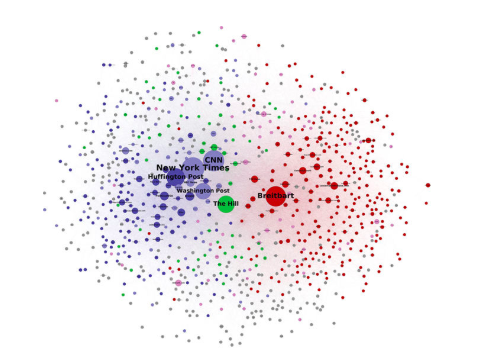
What does it mean that readership of political blogs in the US is politically polarized, according to a recent study of political blogs in the US. Readers on the right and left reading different blogs, and are more partisan than average Americans. Blogging isn't a tool for discourse across the spectrum, but a tool for organizing and message-building.
Is the partisanship cause or effect? "We don't know if blogs polarize their readers, or if highly ideological readers gravitate to blogs that reflect their partisanship." A comment on Crooked Timber, group blog of one of the study's authors has an insight. MQ writes, "I think this stuff is going to change over time. The blog world took shape at an extremely politically polarized time, and the polarization was still there in 2006."
The connection between blog-reading and activism is supported by a multi-national study showing that blog readers in France, Germany, the US and the UK are more likely to be politically active. It would be interesting to find out how many of the the people reading and organizing using blogs have been partisan and politically active all along, and how many have been mobilized by blogs.
Personally, I've become more partisan as a result of reading political blogs, and a more active participant in electoral politics. I got involved in tech policy activism before the rise of political blogging; but the issues weren't particularly partisan at the time. I've become more partisan in part because of the evolution of the right in the US toward defense of torture, government spying, aggressive wars, unlimited executive privilege and other radicalism. And partly persuaded by the argument by Markos et al that the attitude of reasoned nonpartisanship on the part of Democrats enabled them to be rolled by those negotiating in bad faith, the "bipartisanship is date rape" tactic. I admire the Obama campaign's message of hope, but when Obama backpedals on his commitment to the constitution, the right strategy is to organize. It will be wonderful to contemplate varying points of view when the path to compromise isn't "how much of the constitution do you want to give up."
It would be exceedingly interesting to find out whether there are meaningful numbers of people getting mobilized to political activity through involvement in blogs and social media.
The Blogher party last Saturday night was at Macy's, which is a propos. Conventional wisdom is discovering that a network of women bloggers is the next generation of women's magazine. This isn't a sellout shock like yoga fashion; it's not as if BlogHer comes from any kind of ascetic ideal; the founders of BlogHer came from media, and intended from the first to be a new kind of commercial media; The early BlogHer conferences had sessions on how to make money from your blog; now the dream is starting to come true.
Also, there is a basic difference between Parenting Magazine and home blogging - a journalist writing about being a parent and quoting parents in little snippets is different from people writing about their lives. A feature article with quotes from 5 families is different from a comment thread with people talking to each other. The number of voices and kinds of voices in a handful of mass-produced magazines is going to be smaller than the number and kinds of voices in the blogs of individual women. And folk culture does its own transformations of the products of advertising.
And yet there's a big caution from history. One of my favorite books, Ruth Schwartz Cowan's More Work for Mother, tells the story of the way that advertisers helped construct the culture and identity of middle class women in the age of automation. Laundromats and storebought clothing might have enabled women to do other things with their time than clean house and sew; and early feminists argued in favor of using automation for liberation. Makers of soap and manufacturers of appliances allied with people who believed that women's place was in the home, to advocate that women ought to clean clothes more often instead of using their time for other things. When the sources of revenue are makers of consumer goods, how does this affect the lives and conversations of those of us dependent on that revenue? How reluctant do we become to bite the hands that feed us?
There were some excellent sessions on women working in open source communities developing blogging tools; hopefully we will continue to create ourselves as makers not just consumers. I talked to one woman who has a video project on the history of feminism; I hope that the community continues to host that sort of work. And I am hopeful that the lesson of the Obama campaign is that social networks are and remain tools for organizing at the same time as they are tools for marketing.
So, is it legal to use a web forum or internet chat for official public discussion in California?
The plot thickens. I asked informally, through city council folk in two Bay Area cities, and got conflicting responses from city attorneys. One says it's illegal. Another says it's permitted but recommends that officials use the tools cautiously. And neither has provided citations in case law or administrative ruling.
Point to point email is explicitly prohibited under California's Brown Act, which requires conversation among a quorum of public officials to occur only in public meetings. But web forums are different -- unlike an email, which is visible only to the sender and recipients, tools like blogs, forums and wikis are visible to the public.
Teleconferences are permitted under the Bagley Keene act. What about web conference and chat, which are like teleconferences without a phone number, and with or without voice?
In search of some more solid legal grounding, I sent a question to these California open government watchdogs. If I don't hear from them directly, I'll network in.
The new tools are great ways to broaden public discourse. If they're not legal, they should be. The first step is to find out where the law stands.
I discovered another opportunity for fixing, listening to Jon Udell's interview of Carl Malamud on IT Conversations. Malamud's activism was behind the publication of Edgar, and many other initiatives to make public data publicly available. In the interview, he mentioned that Congressional Committee meetings are webcast but not recorded and archived. Well, that's wrong. Sounds like a lovely opportunity for some blog activism, sometime after election season.
On KQED Forum on Friday, David Weinberger noted that the YouTube debate, drew more from the conventions of mass media than the web. The questions came from citizens, but the candidates answered in soundbite format, with minimal follow-up, and the answers were subjected to talking-head punditry. The YouTube debate was a fine news hook for discussion of web politics. Meanwhile, the interesting action, it seems to me, is in local/regional politics.
Firedoglake has a weekly series where progressive candidates talk to the community, and donations are solicited via ActBlue. Recent studies have shown that MoveOn's get out the vote efforts actually got out the vote; the next step is peer GOTV. Once the Netroots help candiates get elected, the next step is accountability. On Calitics, bloggers are calling out Jerry McNerney, who was elected with tremendous netroots support, for voting against medical marijuana. The legacy of the Dean campaign, it seems to me, is less about bloggers covering presidential campaigns and more about activists building the 50 state grass roots base.
David Weinberg has a fine manifesto up on Delamination, the idea that in order to have a free and competitive internet, we need to split access from services. Which is good right and true, and darn hard to do with the government as wholly owned subsidiary of the oligopoly. A good number of the intractable problems in US society come from way too much market power. The problem with Net Neutrality is like the problem with the Farm Bill -- a handful of companies own the market and buy the law, and it's pain in the rear to buy back. Delamination on its own is like saving the whales, a good but atomized idea that's not big enough to sustain. We need to rebuild the trust-busting ideal of the good old Progressives.
Michael Arrington over at TechCrunch criticizes the Google blogger's use of Sicko to pitch ads for the healthcare industry. Why is this a bad idea? In his post, Arrington says it's because the topic is controversial, "Millions of Americans have a serious problem with the way health care is handled in this country, and such a polarized topic is hardly one in which a company like Google wants to take a stand. And if they did take a stand, it would be with Moore." In a comment further down in the thread, he goes further, alleging that the move is unwise because it will "step on certain toes" in the Bay Area. Arrington's implication is that as a company gets bigger, its bloggers need to refrain from controversy and toe the line with respect to politically correct conventional wisdom.
Ross Mayfield is closer on with his critique of the blogger's statement that Google advertising is a "democratic" way of spreading the word about the good side of your industry. Advertising isn't democratic, first of all because it costs money, and second because advertising messages are one way and don't allow readers to talk back.
Building on Ross' point, what's worst about Lauren Turner's post -- from Google's perspective -- isn't that it expresses an opinion about a controversial topic (the health care industry really isn't that bad), or that it overestimates the democracy of online advertising. It's that advertising is presented as the way out of a PR dilemma that caused at least in part by real problems.
The classic lesson of contemporary PR -- from the Exxon Valdez to the Tylenol poisoning to John Mackey of Whole Foods taking on Michael Pollan's critique of "industrial organic" -- is that when there's bad press that has some merit, you should honestly take on the critics, and acknowledge the problems, and make changes. You can't just whitewash your way out of a scandal.
Given the number of uninsured people in the US, the statistics about infant mortality and lifespan and healthcare cost, there's clearly a problem. that is not going to be fixed by pictures of smiling grandmas and cute babies. You can agree with Michael Moore's solution, or like his filmmaking style, or neither. (Disclosure: I haven't seen the movie because Moore's style often bugs me, but I probably agree with his conclusion). Regardless, the US healthcare system has problems and it can't just advertise its way out.
As a provider of advertising services, Google is ill-advised to market their services as a way to escape a well-deserved bad reputation.
He and his crew at Talking Points Memo / Muckraker Report have been doing some of the best investigative journalism about the US Attorney scandal. They have been relentlesslyconnecting the dots about the reasons for the firings, and the apparent perversion of the justice department into a tool to prosecute democrats, protect corrupt republicans, and suppress the democratic vote. Before this story, he was an early investigator of the Plame and Abramoff stories. No dead celebrities junkfood or he-said-she-said abdication of critical thinking. Good, straight-up journalistic oversight from the old tradition, and as far as I can tell, one of the best working journalists alive.
One of the benefits of the blog form for investigative journalism is its strength at serialization. The classic Pulitzer-winning formula is a long-form expose, developed in secrecy for months or years. The resulting stories are in-depth and rigorous, but sometimes hard to follow. The "story" punch belongs to the disaster or celebrity scandal. The stories of systematic corruption are wonky and "boring." The short, serial blog form lets you learn the characters and follow the plot, building an understanding of complex events over time without having to plow through contiguous acre-feet of newsprint. Blogs depend on linking and comments for fame, rather than "scoops," and benefits from shared research by readers. So blog-borne investigative journalism surfaces earlier, as the facts are being discovered. The reader is brought along for the ride with the journalist, who is following the threads, not sure where they will go.
The new D congress seems to have mixed prospects for tech policy. Internet policy looks to be getting better,with Ed Markey, a supporter of Net Neutrality, now chairman of the internet subcommittee of the House Commerce Committee. Copyright looks pretty scary, with Berman (D, Disney) in charge of the committee responsible for IP law. Privacy's looking better, with Waxman looking to investigate government violations. Energy is better than it was when the reps from XOM were in charge. Unfortunately, money seems to be headed from oil subsidies to ethanol subsidies. Given the farm lobby, I wonder if there's any way to stop that boondoggle.
What would it be like if public information: bills and supporters, government spending, campaign donations, were online and mashup-able like Amazon books and Google maps, and collaborative like wikipedia? I had a chance to go to an event put on by the Sunlight Foundation, which is investing in this vision, and admire some excellent tools, such as Maplight, a new, useful and elegant database of political contributions in California, and project VoteSmart,which tracks US and state politicians voting records.
Getting the tools crew together was fun; the next step is to mix it up with users. One of the participants in the "speed geeking" cohort I was in -- this is like speed dating but with tech demos -- was a journalist, and it was a thrill seeing him get excited about all of the lovely sources. As a sometime activist, I also saw the tools with the eyes of a potential user. There needs to be an event with the Sunlight toolset, and the crew of journalists, bloggers, public interest folk, and staffers who would actually use it, to get the word out, and get feedback.
It is excellent that Sunlight is funding this stuff -- it is the old-fashioned, geeky progressive vision that government is better with oversight and transparency. The value is combining the dispassionate data with the energy of folks trying to expose corruption and get good things done.
So, a new generation of tools is getting funded at the same time that the traditional users of the tools -- journalists -- are facing an economically dubious future. The unholy alliance of advertising and news is breaking apart -- the money is siphoning to Google and to Craigs List. There is more than enough great data to keep investigative journalists quite busy, but what is going to pay their rent?
I'm proud of California for electing Debra Bowen, a top-notch advocate for transparent, secure, reliable and open voting systems. And for rejecting Prop 90, the legislative approach that makes environmental and land use regulation impractical, which is currently wreaking havoc on Oregon (the link has telling stories about mining in national parks and neighborhoods. I didn't vote for Arnold; in an era when R has come to mean no-bid contracts, torture, infinite detention, opposition to birth control, and any number of other extreme and unsavory things, I am not voting for any Rs, but I'm pretty pleased that he figured out that he needs to govern as a moderate democrat in order to keep his job.
Not to mention the US, for waking up and throwing the bums out. It will take a lot of work to recover, and build differently, hopefully we can.
Wow. Debra Bowen is running for Secretary of State in California, after her term in the state senate. Einsteinia on DailyKos has compiled a long list of Bowen's legislative accomplishments. Having put in some leather-pump-miles in the Texas Capitol trying to educate legislators about electronic voting, it is just stunning and incredibly gratifying to see a political figure who is so savvy on these issues.
Her achivements include passing bills to use the voter verified paper trail in audits, making sure the audits include absentee and provisional votes, requiring the paper used for the audit trail to be readable for 22 months, requiring a statewide recount policy, enabling citizens to inspect voting systems.
In Texas, we got bipartisan support for a paper trail bill but got shot down because of leadership opposition. Explaining the details -- why you need an audit trail, why you actually need to do the audits, why the paper needs to be good, why you need citizen oversight -- these were all topics that took a lot of explaining. Meanwhile, Bowen has been leading.
Here's a selection, a longer list is at the DailyKos link above.
SB 11 - Prohibits a voting equipment manufacturer or vendor or their agents from making campaign contributions to candidates for state or local office. Also precludes the Secretary of State from supporting or opposing candidates or ballot measures. Passed Senate in 2005, killed in Assembly in 2006.
SB 370 - Requires elections officials, when doing the 1% manual count required by law, to use the AVVPAT produced by electronic machines. Signed into law in 2005.
SB 1235 - This is an expansion of last year's SB 370 (Bowen). The manual count law requires the votes in 1% of the precincts (with some exemptions) selected at random to be counted manually and matched against the results from the electronic tabulator. This bill: 1) Requires all "early voting" center, absentee votes, and provisional votes to be included into this tally; Requires the select the "random" precincts using a randomly generated number method and/or based on regulations drafted by the SOS; 3) Requires the audits to be public; and 4) Requires the results of the audits to be made public. Will be sent to Governor's desk by 8/31/06.
SB 1519- Requires the SOS to promulgate recount procedures. There is no state law or regulation on how exactly recounts are conducted. Instead, the procedures (they vary by voting system) are laid out in an informal "best practices" manual between the SOS and the counties. This requires the SOS to promulgate official regulations, so everyone (including the public) will know how it's done. Will be sent to Governor's desk by 8/31/06.
SB 1725 - Requires counties to "track" absentee ballots so a voter can call in and check to see if their ballot arrived. Will be sent to Governor's desk by 8/31/06.
SB 1747 - Voting machine inspection. Right now, the law restricts the ability of people to inspect voting machines, limiting it to county central committees who can send in "data processing specialists or engineers." This bill expands it to every qualified political party, removes the requirement that they be "data processing specialists or engineers," and permits up to 10 people from a "bonafide collection of citizens." Pending on Governor's desk. He must act by 9/30/06.
SB 1760 - Precludes the Secretary of State from certifying any voting system unless the paper ballots and the accessible voter-verified paper audit trail (AVVPAT) retain their integrity and readability for 22 months. That's how long, under current law, elections officials are required to retain these documents. Also referred to as the "Elephant Gestation Bill," since 22 months is the gestation period for a baby elephant. Pending on Governor's desk. He must act by 8/26/06.
A propose of not much, I finally put my finger on why the "media justice" meme strikes me as going in the wrong direction. In political vocabulary, "justice" is a a buzzword and a code word. It implies a strategy of pursuiing redress of grievances, speaking truth to power, protest.
The lightbulb came on when I was reading an article in the Nation about the need for environmental and progressive groups to rebuild a grass roots base, that quoted Peggy Shepard of West Harlem Environmental Action. That group was born out of street protests to call attention to a sewage plant that had been making people sick for years. The group organized a demonstration that held up traffic at 7 a.m. on the West Side Highway in front of the North River plant on Martin Luther King Day, eventually filed a lawsuit, and catalyzed a $55 million repair operation by the city.
When pollution is making people sick, protest politics make sense. Polluters can get away with it as long as the harm is kept quiet and it's easier for the polluter to continue than to stop. Protest politics raise awareness and make it less convenient for the polluter.
The "justice" metaphor and strategy makes a lot less sense to me when applied to media. When there's a polluting sewage treatment plant or chemical plant in your neighborhood, you don't have a lot of power on your own. You can't shut it down or move it. You rely on recalcitrant business people and politicians to help you. In classic form, you need to organize and and petition those that have the power for redress of greivances.
With media, though, a community group or an individual can easily get a voice and become part of the media. By easy I don't mean trivial, it takes work and information-gathering and networking. But it is within the power of an individual or group of people, unlike, say, shutting down a polluting chemical plant. So, a large part of the focus to get "justice" in media coverage is DIY and entrepreneurial. Don't ask somebody to do it for you, just do it, and then reach out to get the story amplified. There are tremendous opportunities for business and civic entrepreneurship here. Don't ask, do.
There are some aspects of media where political activism is needed, where the rules are overly influenced by folks with concentrated power. In order to get open spectrum, organizers need to wrest it back from the claws of the incumbent oligopoly. In order to get net neutrality, organizers need to win the battle with the incumbent oligopoly - or, harder but better, break the oligopoly. Even then, the rhetoric of petition isn't nearly enough to win the war, since this speaks to a fraction of the supporters. Allies in that battle include the tech entrepreneurs who want to ensure space for a competitive market. They don't see themselves as the powerless asking from help from the powerful -- they want market forces to work, and concentrated oligopoly works against the competitive market.
So, environmental justice is a powerful strategy for a set of problems. "Media justice" plays a much narrower role, motivating a particular constituency on a particular subset of a set of issues where other strategies are a larger part of the solution.
Essembly is a fun toy for people who like to debate about politics and meet likeminded folks, but it doesn't yet do much useful to help you get informed or take action.
The starting point is kinda fun. The system poses some political question. You answer on a scale of one to four, and then the system lets you explain your answer. Some of the questions are put together by the editors of the site, and others by participants.
The explanations are what really make it work as a game. When I filled out their initial quiz, one of the questions was:
Preserving the environment is usually more important than protecting jobs and business.
Grrr!!! What a horrible question! This false dichotomy is toxic to real progress. How about, protecting the environment through clean energy can be a major creator of jobs and businesses. Moreover, reduction in fossil fuel carbon may be the only way to make sure that we have a viable economy that supports the current population.
Once I realized that I could comment, and people could debate each other in their answers, I was less mad and more entertained.
Debate is an important part of political learning, as Scott Henson teaches citing Christopher Lasch, who argues that journalism's goal of objectively informing people is a fallacy, since people really understand things through argument. The advocacy framing provided by blogs like Glenn Greenwald's actually makes news easier to understand, even if you don't agree with the blogger all the time (Greenwald is perilously right, but that's a digression).
The site gives people strong identity, with pictures and background information, which will hopefully help the site stay civil.
The problem is the site doesn't provide good ways to get beyond the opinions that readers bring to the table. I'm not going to go to Essembly as often as I'll go to a blog site that brings and contextualizes news in the context of the readers' opinions, with references to go deepen when I care to.
The site makes it easy to make groups and "friend" people in the social networking site manner. But it doesn't yet provide tools for people who want to do anything more.
What I really want from an activist site is a set of tools that helps not just to affiliate, but to organize. A tool to arrange a group visit to a legislator. A tool to build a mailing list,with distributed administration. A tool to build shared talking points, and to write letters to editors and decision-makers. A tool to donate for a shared purpose.
Essembly is a fun start, but in game terms, it leaves people at level 1.
Immigrants are the latest in a long series of minority scapegoats to bear the brunt of Republican party "divide and rule" electioneering. Thankfully, it's failing. A vast crowd in LA, and big crowds in Denver, Phoenix and Milwaukee gathered to protest a new bill that proposes making illegal immigration a felony and building a wall on the Mexican border.
In the last election, Republicans made headway in hispanic communities; that seems less likely this time around. Hopefully the bad bill won't go anywhere, and Republicans will be harmed by outraging Hispanic Americans more than they are helped by energizing the white bigot vote.
The scapegoat gambit is an old tactic for the Republican party. Willie Horton and welfare queens worked 20 years ago, but apparently demonization of black folk doesn't go over anymore. In the last cycle, the Republicans picked on gays, but tolerance is on the rise, so immigrants came up in the next draw of the scapegoat card.
Are changes to immigration policy needed? Its troubling to see workers with low wages and no protection. But making immigrants felons and building a wall isn't the solution. Running against the "brown hordes" is a transparent appeal to the bigot vote, and I'm glad to see it not working.
Chip links to a Slate article about how lobbying really works -- it's not so much outright dollars for votes, but dollars for access and influence. And making overworked staffers lives easier by writing bills for them.
The problem with the game isn't just access, it's the anti-access that the rest of us have. When doing some citizen lobbying at the Texas legislature, we needed to beg for copies of the bills that the lobby was negotiating and helping to write.
In Congress, bills often aren't available until minutes before a vote. The congresscritters and their staffs don't even have access to the bills, let alone the public. Large bills are available on paper only, locking out anyone who isn't physically in DC.
So, it would be a significant reform to mandate that bills be posted, in full text, on the internet, with a reasonably long lead time, like a week or more, between bill posting and vote.
That would give citizens more opportunity to contact their legislator before a vote. It takes a lot of citizen contacts to outweight a few lobbyists in fancy suits, but lots of citizens can have some influence.
The big finance reform would be public finance and free media. That's a huge step for our well-bought system. Instead, we get incremental proposals that cause money to slosh back and forth among different contribution structures, but have less affect on the economy of access.
Openness can do at least as much as more campaign finance regulation can to improve the access equation.
As reported in <Badger Blues via Daily Kos, and Slashdot the law requires that:
"If a municipality uses an electronic voting systm for voting at any election, the municpal clerk shall provide any person, upon request, at the expense of the municipality, the coding for the software that the municipality uses to operate the system and tally the votes cast.
This is a great step toward making voting technology serve the public rather than voting system vendors.
Wisconsin law already required voting machines to produce paper ballots that can be used in a recount.
UPDATE: Unfortunately, the report was based on an old version of the bill. The version of the bill that passed requires an non-disclosure agreement be signed for code review. So much for transparency and public scrutiny.
Also, the "paper trail" language doesn't require that the paper ballot be viewed by the voter before it is cast, so it's toothless also.
Matt Yglesias, John Cole, and Ezra Klein have picked up the question about data mining math. If you're looking for a small enough needle in a large enough haystack, will the noise outweigh the signal?
Ezra Klein asks the question nicely:
I’m not necessarily against a program of this sort if properly executed, but why is it such high priority? Bush keeps mentioning how we needed to “connect the dots.” Only problem is, he doesn’t seem to understand the phrase. Pre 9/11, the NSA, the FBI, the CIA, the FAA, and a variety of other groups had collected isolated bits of information and surveillance that, if laid out on the same desk, would’ve laid out the 9/11 plot in considerable detail. We had FBI officials noticing the Al-Qaeda members in flight school, NSA intercepts calling 9/11 “zero day,” agents theorizing that hijacked planes would be turned to missiles, and so forth. But none of that mattered. Because while we had the dots, we lacked the ability to connect them.
At best, this NSA program collects tons more dots, but are we connecting them? Do we have the ability to process this much information? Or are we dangerously decreasing the signal-to-noise ratio? In short, why is this program necessary? We had the intelligence under the old protocols, we just didn’t process it. Why is the answer more data and why should we be confident that the government has the resources to sift through it?
This Ars Technica piece makes the argument about the ineffectiveness of mass surveillance at catching terrorists.
Just imagine, for a moment, that 0.1% of all the calls that go through this system score hits. Now let's suppose the system processes 2 million calls a day. That's still 2,000 calls a day that the feds will want to eavesdrop on—a very high number, and still much higher than any courts could possibly oversee. Furthermore, only a miniscule fraction of the overall total of 2 million calls per day on only a few days of each month will contain any information of genuine interest to the feds, and the odds that some of those calls will be among those that catch the governments interest are passing slim.
Targeted human intelligence has always been and will always be the best way to sort the sharks from the guppies (to change fish metaphors). Government money invested in much less intrusive and much less defense contractor-friendly programs like training more Arabists and developing more "human assets" in the field will be orders of magnitude more effective than mass surveillance could ever be. Blunt instruments like airport facial recognition software and random subway bag searches produce much more noise than they do signal, and any engineer or computer scientist worth his or her salt will tell you that an intelligent, targeted, low-tech approach beats a brute-force high-tech approach every time."
When you're looking for a needle in a haystack, the number of false positives is going to be enormous. Sifting through these low-quality false positives can overwhelm legitimate law enforcement resources to pursue high quality leads.
Investigate by all means, but before investigating the homes of US citizens, get a warrant.
There's a lot of speculation that the warrantless spying authorized by the Bush administration is using some kind of TIA-like, Echelon-like massive data gathering and data mining operation.
That's why the administration couldn't get FISA warrants. If that's what they're doing, it's arguably a bad idea even if it was legal (which right now it pretty clearly isn't).
You can get warrants if you are spying on one, or five, or twenty people. You can't get warrants if you are spying on 100,000 people, or 1 million people.
It's also why they couldn't use the "after the fact" exemption in FISA. Under FISA, the government can start spying immediately, and ask for the warrant up to 72 hours later. But if you've amassed petabytes of data on millions of people, the analysts haven't analyzed it all in 72 hours. Maybe they go back and look for a pattern months after the fact.
Even if it was legal, though, it would arguably be a bad idea. Bruce Schneier makes the best argument that data mining is in many cases less effective than traditional, lead-based investigative work.
When you're looking for a needle in a haystack, data mining is bad math. It's very different from the use of data mining to detect credit risk patterns. In the US, there are probably tens of millions of people who are iffy credit risks, and there are different probabilities of default. It's reasonable to use math to assign a credit rating based on probability. And there's a competitive market for credit. If an individual gets turned down by one provider, they might get credit from another. It's not a binary thing.
But what about looking for terrorist sympathizers. Islamist terrorists in the US are rare. How many potential terrorists in the US are willing to kill innocent civilians -- maybe 100, 200? Not that many. How big is their network of sympathizers and supports? Maybe a few thousand? By contrast, how many people are there who are news buffs, ordinary muslims, and ordinary, never-violent political activists? Many millions.
So a data mining operation that looked for keywords would find many many more innocent people than potential terrorists. The government would waste their time reading this blog post and menus for mosque community dinners.
When you are looking to assess a credit rating, being about right is OK. If someone pays a rate of 15% instead of 14%, not that much harm is done. But when you are looking for a terrorist, you want to be 100% right. It doesn't help if you miss a killer and abduct uncle abdul the hardware store owner.
The government would be much better off doing the traditional job of finding leads, getting warrants, trailing those people, and finding their contacts. That sort of hard work actually has a higher probability of success than the data mining approach.
as reported in Forbes. Of course. Nobody is arguing against the needed surveillance of suspected criminals.
And if law enforcement wants to eavesdrop on a US citizen or a resident, they need to be authorized by a judicial warrant. The missing word in Cheney's remarks is "warrant".
The terms of FISA are quite liberal -- the government can start eavesdropping immediately, and ask for judicial review up to three days later. If for some reason, the terms of FISA hampered legitimate investigation of terrorists, the administration should propose a change to the law.
Our constitution does not allow the president to disregard the law, or to make law by fiat. That's called monarchy or dictatorship.
Over the years, I've argued in favor of calling the office Christmas Party a Christmas Party, since that's what it is. If generic christians really and truly wanted to be ecumenical, they'd also hold Purim parties and Diwali parties -- they'd really celebrate when other ethicities party, instead of condescendingly including Hannuka with Christmas.
Last season, the war on Christmas seemed like a joke - a joke on the humorless, paranoid ultra-Christian scrooges who managed to sustain a persecution complex when they're part of the majority culture.
This year, it's not so funny anymore.
I'm not offended when someone untentionally wishes me a Merry Christmas. But I do appreciate it when people who know I'm Jewish say Happy Hannukah. The point isn't about people in the minority being offended. It's about people in the majority being considerate. So the "war on Christmas" folks are waging a war on politeness. But I'm getting the sneaking suspicion that it's worse than that.
Wishing a "Merry Christmas" becomes a test of club membership. If a non-Christian doesn't eagerly welcome the greeting, we're "them", not "us". What the "war-on-Christmas" people are trying to do is to subtly and insidiously create the impression that people who aren't Christian and aren't faking it are somehow less American.
It's good to see that ACLU Texas is prosecuting the war on Christmas with the vigor it deserves.
After Congress returned from recess to vote for the Terry Schiavo bill, I followed the news obsessively, looking for signs about whether the American people would embrace the creepy, intrusive conservative nanny state trend. Thankfully they didn't; the Schiavo law was the beginning of the Bush administration's loss of mainstream, independent American voters.
The NSA wiretapping story feels to me like a similar moment. Will the American people buy the John Yoo theory that anything the president does with a national security justification is by definition legal? Or will they agree with Russ Feingold that "The President does not get to pick and choose which laws he wants to follow. He is a president, not a king."
Update:
* this reading of FISA indicates that the surveillance should have required FISA warrants.
* comments here raise questions about whether the surveillance should have been covered
* more facts are needed. This needs to be investigated immediately.
* the "Bush Doctrine" that the president can use national security justification to disregard the law was and is unamerican
According to a syndicated NYT story run in the Houston Chronicle, only 3 percent of employees at the Department of Homeland Security said they are confident that personnel decisions are "based on merit." ... "Only 12 percent of the more than 10,000 employees who returned a government questionnaire said they felt strongly that they are "encouraged to come up with new and better ways of doing things."
"In each instance and many others, the responses of the Homeland Security employees were less favorable than those of all the other departments and agencies surveyed by the federal Office of Personnel Management, a new study by an outside research organization shows."
The article didn't cite the survey. The results look ominous for terrorism prevention and disaster readiness.
My mom reports that she is now able to carry knitting needles on commercial airplanes for the first time since September 11.

This is from an interview in Grist with Chris Mooney, author of the Republican War on Science. The interview has a great quote about the way that "he said/she said" journalism leaves the press open to puppetry by interested parties. The quote applies to any topic, not just the abuse of science. (I haven't read Mooney's book, so I don't have an opinion on it).
Here's my real fear when it comes to the press. Suppose there's some mainstream scientific view that you want to set up a think tank to challenge -- to undermine, to controversialize. Suppose further that you have a lot of money, as well as an interested and politically influential constituency on board with your agenda. In this situation, it seems to me that as long as you are clever enough, you should be able to set your political machine in motion and then sit back and watch the national media do the rest of your work for you. The press will help you create precisely the controversy that lies at the heart of your political and public relations strategy -- and not only that. It will do a far better job than the best PR firm, and its services will be entirely free of charge.
The New York Times has the scoop on piles of suspicious findings in the $1.5 billion in Hurricane Katrina reconstruction contracts.
More than 80 percent of FEMA contracts were awarded without bidding or with limited competition. The largest deal was $568 million in contracts for debris removal landed by a Florida company that was a former lobbying client of Mississippi governer Haley Barbour. What better deal than to promote your lobbyist to have purchase signoff authority?
The second best deal is to have the buyer's ex-boss be the lobbyist. Two contractors, the Shaw Group and Kellogg, Brown & Root, a subsidiary of Halliburton are represented by Joe M. Allbaugh, the retired head of FEMA who recommended his college buddy Brown to take over when he left to lobby for reconstruction contracts.
The contracting practices are starting to smell like fish in a freezer with the power out.
Meanwhile, Time hunts for more Mike Browns.
The Project on Government Oversight has been tracking the story.
The latest juicy tidbit: the administration's top procurement official, David Safavian, had been working on developing contracting policies for the Katrina relief effort. He was arrested for obstructing an investigation by the GSA's Office of Inspector General. Safavian allegedly helped lobbyist Jack Abramoff aquire GSA-controlled property the Washington, D.C., then lied about it to the investigators.
Laura Rozen is collecting reports on the Safavian investigation.
The Louisiana reconstruction has the potential to be a vast cesspool of corruption. Hopefully some investigative journalists smell one-in-a-lifetime muckracking opportunities and will be following the money.
Here's one bad smell: "A bill introduced in the House [last week] by Rep. Kenny Marchant (R-Tex.) and co-sponsored by Rep. Thomas M. Davis III (R-Va.) would waive rules for congressional notification of certain no-bid purchases".
And another: The LA times reports that "Senior officials in Louisiana's emergency planning agency already were awaiting trial over allegations stemming from a federal investigation into waste, mismanagement and missing funds when Hurricane Katrina struck. And federal auditors are still trying to track as much as $60 million in unaccounted for funds that were funneled to the state from the Federal Emergency Management Agency dating back to 1998."
One of the few good things about the D/R fingerpointing is that the Democrats will be keeping an eye on the Feds and the Republicans will be keeping an eye on the locals.
Yesterday, the House decided not consider an amendment to the Patriot Act which removed the secret searches of libraries. The measure that passed by bypartisan majority earlier today. The House bill extends the notorious Section 215 for 10 years, allowing the FBI to search business records, library records, bookstore records, medical records, commercial purchase records without probable cause.
However, you can compensate with civil liberties schwag:
Handy fourth amendment totebag, protected in theory from searches and seizures. Now sold out, but you can ask the seller to make more.

Disappearing civil liberties coffee mug:

According to this AP story, the FBI has amassed thousands of pages of records about the ACLU, Greenpeace, and other civil rights and advocacy groups.
If nothing else, the FBI is proving the case of critics concerned about expansion of domestic police powers to investigate terrorism. Of course, it's probably easer to investigate the ACLU, which has offices in the phone book and leadership that makes regular media appearances, than to investigate Al Qaeda sleeper cells.
Belated kudos to the superb series by Ezra Klein comparing the health care systems in various other countries, including Canada, Britain, France, Germany and Japan.
Klein's serices brings clarity to a subject that is usually treated with a mix of ideology, and mind-numbing, detail-encrusted jargon.
The analysis shows that the US is getting a bad deal with our current health care system. The US spends more than $5,000 per person on health care, despite not covering 43 million citizens. Japan covers all of its citizens for $2,000 per person. Germany covers 90% of citizens through its public program for $2,817 per person. Canada covers all of its citizens for administrative costs that are 1/3 of the US costs per capita. The higher costs in the US don't buy better health. The US comes out worse in measures of preventable premature death.
The systems are structured differently: France has three programs for different occupational groups. Japan has three programs for big business, small businesses, and the retired or self-employed. The programs in Britain and Canada are separate from employment. They also treat private insurance differently. Britain, France, and Germany allow supplementary private insurance, while Canada prohibits it.
They differ in the level of choice: Britain and Canada use a gatekeeper system, where a patient needs to first go to a general practitioner and get a recommendation to a specialist. Japan does not limit hospital or physician choice, and in most cases does require a gatekeeper. Neither does France, although they are moving to a primary doctor system.
The ill-fated Clinton plan was based on the German system. German health care is funded through employer contributions, with half the money coming from the employeer and half from the employee. Germany has different "sickness funds", specializing by region and occupation, which compete for members. Germany spends $2,817 on health care for its citizens compared to $5,267 for the US.
When the Clinton plan was up for debate, I looked unsucessfully for a clear explanation of how health care systems worked. Ezra Klein has done an amazing job showing the structure of health care systems. And he links to his primary sources, so the diligent can check the facts.
If you want to grok health care in a few short posts, check out Health of Nations.
As reported by Scoble, Microsoft is again in favor of the bill that bans discrimination against gay people in housing employment. (though it's too late for the Washington legislative session this year).
The reversal was prompted by widespread complaints by Microsoft employees and media coverage, after the story was broken by The Stranger, an alternative newspaper in Seattle, and John Aravosis of AmericaBlog. So much for the lobbyists's boast that nobody would notice.
In a memo posted on Channel 9, Microsoft's online forum, CEO Steve Ballmer explained why Microsoft is taking a position on a public policy question:
I’m proud of Microsoft’s commitment to non-discrimination in our internal policies and benefits, but our policies can’t cover the range of housing, education, financial and similar services that our people and their partners and families need. Therefore, it’s appropriate for the company to support legislation that will promote and protect diversity in the workplace.
I am very happy to see the Microsoft executive team do the right thing, and glad that enough people spoke up to help the execs change their minds.
An airport security guard doing the pull-aside on Socialtext CEO Ross Mayfield says that we're now restricted to two books to carry on airplanes.
So now you can tell terrorists because they're reading too many books? Or the government thinks that people who don't read will be more susceptible to idiotic pseudo-security.
This needs a little bit of investigation and if true, a lot of mockery.
UPDATE: Apparently, a poorly trained security guard was confused between books of matches and books for reading.
The last post was about tools and techniques to give more power to "bottom-up" organizations, and enable top-down organizations to get more done by empowering members. I see the pyramid getting flatter (or more arrows feeding into the network nodes), but I don't see hierarchy disappearing for two reasons: attention and television.
The first reason is attention. In a complex society with a thriving democracy, most people can only commit a fraction of their time to civic activity. Organizational structures need to reflect hierarchy of commitment in attention and time -- from people who's willing to learn a bit and vote, to people who are committed volunteers, to people who have full-time public sector jobs.
Representative democracy takes the attention limit into account -- there's a relatively small number of people who are delegated to do the public's business full time. These representatives are chartered with soliciting public input and making decisions.
There are alternate models of representation that are more democratic, but the representative structure demains. In the model of deliberative democracy promoted by Tom Attlee and others, deliberation is conducted more along the lines of extended jury duty. A group of ordinary citizens is chosen. They focus a significant amount of time studying and deliberating an issue, and then make a decision. This model used in the British Columbia project to choose a voting method.
The process of educating government decision-makers -- lobbying, that is -- can certainly be more democratic than it is -- well-trained volunteers can get a lot done, at least on the state and local level. But there's a practical limit to the number of people who can pursue face-to-face lobbying as a vocation or avocation.
The other source of hierarchy is television. Television is in persistent decline, but remains the single most effective means of political persuasion. It is conventional wisdom that in an election, television generates 48% of the voting decisions, and field get-out-the-vote activities get the last 3%. TV ads are extremely expensive, and the arts of ad polling and message-testing are in the hands of a small handful of wizards.
Young people (ages 18-34) use local tv news and the internet more than national news and newspapers for information according to a Carnegie study. The study reports that "the Internet, is number one among men, high-income groups, and broadband users." According to the survey, young people say that the Internet, by a 41-to-15 percent margin over second ranked local TV, is “the most useful way to learn.” As net technology diffuses, we can expect the use of the net to increase.
Some day in the foreseeable future, TV will no longer be the dominant medium for political communication. Until then, the wizards will rule.
Even when TV is a less powerful presense, the dynamics of attention will recreate hiearchical structures. This is always true in democratic societies - leaders gain support from shifting groups and trends among constituencies. The means of gaining support, and means of assembling constituences are changing. The network map is changing as we watch.
Several of the rural legislators in both parties who support municipal wireless for their districts and for the bandwidth-starved towns of rural Texas are among the group of sponsors of a clutch of bills proposing to increase the state's renewable energy standard.
The website of Texas Impact (I love Google) explains the story behind the Texas renewable energy bills.
In 1999, then-Governor George W. Bush signed historic Texas legislation establishing the nation's first "renewable power standard" or RPS. The law set goals for how much of Texans' electricity would come from renewable sources like wind and solar power. Texas has the best potential for renewable energy of any state. The 1999 law set a modest goal of three percent by 2009, meaning that by 2009, three percent of Texas electricity would come from renewables.
Texas is likely to reach the 2009 standard this year. And rural Texas stands to gain from the jobs provided by increasing renewables, mostly wind power. So several legislators are proposing increasing the renewable targets:
The Texas Renewable Energy Industry Association is seeking 10% by 2015 because of concerns about building transmission for the amount of power in the next decade.
Anybody with domain expertise is most welcome to comment on the merits of the different goals. Is it the case that more is better? Is there a practical limit with how fast we can move?
Increasing renewables isn't just a tree-lover's dream. It's also one of the best things the US can to increase national security -- what Friedman calls the geogreen strategy. The Wahhabi think tanks that fuel Islamic fanaticism are funded by the Saudi government, which we subsidize with our oil dollars. Just a little less profit margin to the Saudis, and they reduce their exports of terrorism.
It seems like basic supply and demand economics. Starting more mideast wars increases oil prices and increases the supply of anti-American zealots. Increasing consumption of renewable energy and using less oil reduces the supply of anti-American zealots. Plan B sounds better to me.
p.s.
According to a market research report released earler this month by Clean Edge, Inc. solar, wind, and fuel cells are poised to grow from a $12.9 billion industry today to $92 billion by 2013.
The total US energy market was $350 billion in 2002, so clean energy has a total market share of under 4% (not counting increases in oil prices). A better way to measure market share would be in units of energy consumption, not dollars, but CleanEdge doesn't publish units.
According to the US Dep't of Energy cited on this vendor's page overall US energy consumption is growing at 2.2% a year. Taking out my trusty napkin, if you run CleanEdge's 30% growth rate on units, the US gets to 35% market share by 2013, which is over the tipping point for the mainstreaming of new technology. But is it fast enough to save civilization from global warming?
Prescription for Change is a very funny take on a serious topic -- drug companies are regulated before they release a drug, but they aren't obligated to disclose nasty side effects after the drug is on the market.
The video features the Austin Lounge Lizards and Animation Farm of Austin. It was produced by my friend Kathy Mitchell of Consumer's Union, the parent organization of Consumer Reports magazine.
This LA times article describes a three-way tie for LA mayor. The article describes the polls, the levels of ethnic support, the ads, the ad strategies (should they go negative?), and some scandal in the incumbent's office.
Yet, the article says, "more than four in 10 likely voters say they do not know enough about Hertzberg [one of the challengers] to have a positive or negative impression of him." The article doesn't help in the slightest. It says little about the candidates' backgrounds, positions, and beliefs. It says little about the incumbent's achievements or lack thereof.
So, this article is about a poll, maybe that explains it. But a search on the name of one of the candidates reveals a similar lack of substance in other campaign stories. In one story, the candidates compete with rain. In another, they compete in the news with mudslides. The paper goes out of its way say that the candidates are less interesting than the weather.
Maybe elections in LA are purely tribal, maybe people are bored with the election, but the newspaper is part of the problem.
In which David Frum objects to gay marriage because it somehow abolishes
the idea that husbands and wives each have special duties to one another, and that a husband's duties to his wife - while equally binding and equally supreme - are not the same as a wife's duties to her husband."
Frum's statement is illogical because the "duties" that he is talking about -- whatever they are -- aren't anywhere near the law. I am curious, and at the same me, very leery to know what he means by these things that he doesn't mention out loud. Is it:
* a husband's obligation under Jewish law to satisfy a wife sexually (true)
* a wife's duty to have dinner ready and the table set by 7pm?
* a wife's duty to submit humbly to corporal punishment?
I am not looking to the day when these duties are spelled out and somebody tries to put them into civil law.
Grits for Breakfast just won a Koufax award for best single-issue lefty blog, for its coverage of criminal justice reform in Texas. Scott Henson's blog includes original research and insightful coverage of an important issue that is badly undercovered by the mainstream media.
The Koufax awards inspired others to share links of favorite niche blogs.
Meanwhile, Salon picked up the Daou Report, a compilation of thumbnail clips from political blogs, right and left. Skimming the Daou Report, I get a headache from the snippets of insults -- "The Petulant Left", "wingnuts plan to keep women scared", back and forth like 4th grade recess.
Complaints about the dreck in the blogosphere are missing the point. There's infinite space -- anyone can choose to read good sources like Scott, easily find other good sources, and ignore the spitball fights.
At the urging of Aldon Hynes, I just got around to watching EPIC 2014 -- the flash-animated dystopia about the death of the news. I'm less worried about this dystopia than other scenarios of doom.
Epic tells a history of a future in which by 2014, the New York Times is displaced by GoogleZon, an algorithmically-generated stew of peer-created content, narrowly personalized to the preferences of the individual user.
But the big threat to the New York Times isn't Google News, which links to traditional news sources. People who get their news from Google wind up reading more traditional sources than people who just read their local paper.
EPIC envisions an AI that constructs news stories themselves, not just a portal to existing stories. But the AI to write an interesting story is a lot harder than the AI to assemble a page of stories based on a popularity algorithm.
The passive faith in AI is belied by the real process of using Amazon recommendations and Technorati today. Amazon algorithmically assembes a set of recommended books, each with a set of human-written recommendations. The reader critically sifts through the recommendations, separating the cogent from the illiterate. If Amazon were building its recommendation service, the recommendations would be linked to deeper blog and profile information about the reviewer, providing further material to check trustworthiness.
Meanwhile, the formulaic crime-and-accident coverage of today's local news might as well be written by a bot. In-depth coverage by special-interest bloggers not infrequently beats the shallow, formulaic coverage of the mainstream media.
Also, I don't think personalization is as big a problem as EPIC makes it out to be, although folks have been worried about it since Nicholas Negroponte popularized "The Daily Me" in the mid-90s. Social networks with external links can broaden cultural reference at least as much as they shrink them, and surely more than the narrow mass media. I can get more diverse music references in a couple of hours with iTunes, LastFM, Webjay, Amazon and Google than in a lifetime with ClearChannel.
Not to mention the fact that newspaper circulation has been falling since the 60s, under competitive pressure from radio and TV. EPIC deplores and bemoans a world where the news is shallow and sensationalistic -- but that world was created by TV "disaster-of-the-day" coverage.
The big threat is from Craigslist, which cannibalizes the classified ad revenue that accounts for the newspapers' profit margin. Good investigative journalism takes money and time. Journalist need money to eat. It's an open question whether alternate business models -- different from the classified and space ads in traditional newspapers -- will generate enough money to keep investigative journalism afloat.
In a way, I'm glad that the mainstream media and the R's are underestimating Howard Dean, making jokes about "the scream", hordes of latte-swilling leftists with bad hair, and wacky radical ideas.
Meanwhile, Dean's platform calls for rebuilding the party from the ground up, supporting candidates in local elections, building a message bottom up.
The most compelling bit about Adam Werbach's jeremiad about the death of environmentalism was the vision for a New Apollo Project that would invest in clean energy infrastructure, end dependence on foreign oil, reduce contribution to global warming, and create new business opportunities and jobs.
When Werbach and his team took the story on the road to a town struggling with the lost of manufacturing plants, they were astonished at the hope and enthousiasm that the vision inspired.
Ironically, the rest of the speech is a classic jeremiad exhorting environmentalists to renounce their faith in jeremiads. An environmentalist myth tells a story about a pristine beginning, followed by decline and gruesome collapse and decay. So Werbach tells the elegaic tale: the idealistic beginnings of the environmental movement in the vision of Rachel Carson's Silent Spring, through its decline into policy wonkdom and voter-alienating pessimism, and defeat at the hands of cheerful Republican exploiters.
The screed about the death of environmentalism is aimed at persuading old true believers to give up hope in winning environmental issues on their own, and to join the broader progressive movement. If you're not an old-time true believer, the speech isn't meant for you. If you're an old-time disbeliever, the speech will confirm your stereotypes.
Here's the lesson for rest of us, who are looking to assess today's situation, and what to do now. Diamond's Collapse wants to be our generation's Silent Spring. In "Collapse", Diamond argues persuasively that societies need to make foresighted decisions to avert the collapse of their civilization brought on by environmental destruction.
The way to inspire people and leaders to make those good decisions isn't just fear. Fear alone will lead people to put their heads in the sand. The way to inspire people is to provide an hopeful vision that reframes the threat of scarcity into an alternatve vision of abundance.
I'd love to hear a political candidate wrap a story of energy independence, technology progress, business opportunity, and national security. It uses the same story, framed as hope, not fear.
What do do about this?
From a comment on Adam Rice's blog
"Two weeks ago, my husband’s relatives in Louisiana were still defending the invasion of Iraq based on the “connection” between al Qaeda and Saddam Hussein."
It's obviously conterproductive to call that point of view ignorant and stupid -- you don't persuade people by calling them dumb.
But how do you change people's minds when they believe something that just isn't true?
There are two different phases in politics.
In the heat of an election or issue campaign, it's time to act. The story has been framed long ago. Partisans know what they want, engage fellow partisans to take action, persuade fence-sitters to engage by interest and identity. When time to act is short, it's counterproductive to return to first principles and question assumptions.
When a decision isn't at stake, it's time to talk and think. It's time to talk to others with different views and ask questions - why do they hold their beliefs, What are the underlying values and motives? Who do they listen to, and why?
It's time to think about how to reframe the discussion; what's important, what will work, how to talk in a way that will be heard.
A stalwart lefty colleague who lived in a red state for many years pointed to this New York Times article -- an unselfconcious exporation of the offensive stereotypes New Yorkers hold for benighted out-of-towners.
This type of smug response won't help build a majority to win elections.
On the other hand, the right-wing stereotype of a "liberal elite" -- referring to people with college degrees -- is toxic and chilling. The demonization of an educated population has a very long and dangerous history around the world -- China and Cambodia made particularly practical use of this stereotype.
The Coyne post brought a damning statistic from another exit poll: 80% of Bush voters said they voted for their candidate, rather than against the other one. Barely a third of Kerry voters said the same.
A big problem with the election is that voters didn't find Kerry to be a compelling candidate.
Andrew Coyne writes a useful critique of the CNN exit poll showing the predominance of "moral values" among Bush voters. The result may be an artifact of the way the question was asked. The poll separates national security issues: the Iraq war and the fight against terrorism, but hides wedge issues like abortion and gay marriage behind the code word "moral values".
True, it found the largest single block of voters identified "moral values" as the "most important election issue" -- a much cited factoid -- and that 80% of these respondents voted for Bush. But that hardly makes this election a triumph of theocracy. In the first place, "largest single block" turns out to mean 22%, meaning 78% of voters -- including two-thirds of Bush voters -- named some other issue.
Second, the pollsters only managed to elevated "moral values" to number one by dividing up the other issues into subcategories. Thus "Iraq" and "Terrorism" are treated as separate issues, though grouped together as, say, "national security" they would have claimed the top spot, with 34% of the total. Likewise "taxes" and "economy" were named by a combined 25% of voters. Had "moral values" been split into "abortion" and "gay marriage," the spin would have been rather different.
Still, the degree to which the Republican party is beholden to the Christian right is cause for concern. In Texas, the Republican party platform claims that the US is a Christian nation. Moderates who voted for Bush may find that the Republican administration acts against their interest, in favor of religious right interests.
To be fair, Bush's post-election speech was remarkably free of Christian right proposals and military expansionism. We heard about social security reform and military offensives in Iraq, not about banning abortion, halting gay adoption, and declaring new wars on Iran, Syria, and North Korea.
A USA Today poll yesterday found that 63% of voters wanted Bush to advance programs both parties support, rather than advancing a Republican agenda.
Given evidence from Bush's first term, I have very little trust that Bush will respect this public opinion, but would be happy to be proven wrong.
Hope.
There was strong voter turnout and more people were involved. Halley Suitt writes
Call me Pollyanna, but I compared it to being a person who was out of shape, decided to run the Boston Marathon, had never run any long distance and then didn't manage the 26 miles but ran a very impressive 10 miles.
That's how I feel about my experience. I started to be involved in politics and learn about being a net citizen and get right in at a grassroots level like I had NEVER done before.
Okay, I didn't run the whole marathon. We didn't win. But I can run 10 miles now! And I couldn't do that before.
The election was close. 1% nationwide, a bit more ground organizing in Ohio. Youth polled for Kerry, but still had low voter turnout. Many Americans are not well informed. There are things to improve, that can be changed.
Fear. After four more years of mistaken war against nation-states, based on misunderstanding the nation of non-state terrorism, what damage will the US have created in the world? How much riskier will the world be? After four more years of reckless spending, how bad willl the US economy be?
Fear. 51% of voters voted for Bush. But 75% voted for the amendments restricting rights for gay people. The campaign's gay-baiting has won the election overall on "moral issues."
Two women friends of mine, a lesbian couple, are about to have a baby. These laws deny them rights to visit each other in the hospital and give parental custody to a parent who's raised a child.
This is a moral issue, with good on the side of the loving family. The size of the opposition to this moral view is deeply chilling. It makes me worry about whether we'll face a flood of pro-Christian fundamentalist legislation, and what constitutional protection will mean in four years.
(Interesting... this is the first election that I can remember in which Republicans abandoned Willie Horton/welfare queen race-baiting, and used gay-baiting to fill that rhetorical niche in the campaign.)
Exit polls show that the most important issue for Bush voters were "moral values". 11 states voted to restrict civil liberties for gay people. The religious right won the election.

Young people favored Kerry, but they didn't vote.
On the inverse of apathy, Austinites and out-of-towners might want to check out Grits for Breakfast, a new blog by Scott Henson.
It's a good blog to read for personally-engaged reportage in the middle of a deep story. Scott is part of the ACLU-Texas team working to reform the criminal justice system. The latest post describes a Town Hall Meeting in Grand Prairie, halfway between Dallas and Fort Worth, where Latin American groups are allied with a conservative Republican politician to moderate the madness of criminal justice in Texas, where there are 1,941 separate felonies on the books, including 'electrocuting fish,' and in some cases, prostitution, graffiti, and stealing cable. One in 11 Texans is a felon, and one in 20 is currently in prison, on probation, or on parole.
In classic blog form, Scott discloses biases; he's working for the conservative Republican representative's reelection campaign, despite differences on abortion and other social issues because of Allen's leadership on criminal justice reform.
With persistence and savvy, Scott and others on the ACLU-TX team are building alliances and changing minds, engaging in the kind of political conversation across traditional barriers that Lessig wants to revive.
I read Dan Gillmor's We the Media a few weekends ago. Good coverage of weblogs and the rise of peer media. If you've been reading Gillmor and watching the evolution of peer media daily, the book won't be new. If you're interested in the topic, it's an excellent introduction.
A few local data points: Scott Henson's telling stories about drug war injustice, and Mike Dahmus covers the commuter rail issue.
The response to Kerry's mention of Dick Cheney's daughter is a Rorschach test that diagnoses three different attitudes toward gay people.
1) Gay is normal. among the young, libertarian, and socially tolerant, gay identity is like height and hair color - a neutral identifying characteristic. Mentioning Mary Cheney highlights the hypocrisy of Republicans who advocate laws to restrict the rights of people in their own families.
2) Gay is embarrassing. Among ordinary older folk, being gay is still embarrassing. People who are socially prejudiced may not be in favor of laws restricting the rights of gay people, but they consider it rude to identify a gay relative in public. Lynne Cheney's reaction is an example of this attitude.
3) Gay is evil. Among Christian right wingers, being gay is evil. People who didn't know that Mary Cheney is lesbian might not vote for her dad because he didn't successfully protect her from Satan and forbid her sinful lifestyle.
It's clear from the reaction that Kerry miscalculated. If Kerry spoke naively, as a New Englander who takes a level of social tolerance for granted, he underestimated the strength of garden-variety social prejudice. If Kerry meant to speak simultaneously to groups #1 and #3, then the tactic backfired badly by not taking #2 into account. The Rove Machine won the spin by building an alliance between groups #2 and #3, the prejudiced and the fundamentalists.
To those who watched the debates, Kerry clearly won, according to surveys of debate-watchers. He came across as competent and compassionate, stronger on international and domestic issues. But to the larger population who only see snippets of spin on TV, Kerry comes off as a bad guy.
Political speech is difficult because of the need to communicate to people with different worldviews and vocabularies. Great political speech builds common ground. Ordinary political speech is slippery and calculating -- it is intended to mean different things to different people. Ineffective political speech fails both ways -- it doesn't build common ground, and it doesn't assemble a majority by meaning different things to different people.
Demonstrations were among the main reasons why I was politically agnostic in high school and college. The student bodies were fairly liberal, and there were episodic demonstrations on a series of issues: anti-nuclear, anti-apartheid, against US Central American policy, pro-clerical-workers strike, busing to Washington for pro-abortion rallies.
The demonstrators had slogans but didn't have particularly cogent explanations. I have stronger opinions on the issues now, having learned how to research, and having more perspective to weigh conflicting evidence. Students seemed to go to demonstrations the same way they went to parties -- word spread about the cool place to mingle with friends. Instead of alcohol, slogan-chanting made people feel good and lowered inhibitions.
What was worse, it wasn't clear to me how gathering in a sports field was going to have the least bit of difference on the policy issue. Ronald Reagan and international arms control negotiators weren't going to pay any attention to a group of young people standing on the grass and chanting slogans.
Only on apartheid divestment did a group of students -- with wealthy alumni parents and allies -- have a direct impact on the people making decisions.
Demonstrations still puzzle me most of the time. When the faithful rally on the issue of the day, what are they trying to achieve?
The classic civil rights demonstrations revealed that there were massive numbers of people who cared about racial equality -- enough people to effect elections. The demonstrations made it impossible to ignore segregation. Massive demonstrations provided confidence and unity to people who were isolated and downtrodden.
But it's really hard to see what most demonstrations and rallies achieve these days, other than making the demonstrators feel good. Politicians pay attention to money and voters. Demonstrators want to get on TV. But television-watchers will just see a bunch of yelling people. Does that actually persuade any of the TV-watchers to change their minds?
The attempts in Boston and New York to pen up and stifle demonstrators were disturbing. The constitution protects the right to peaceably assemble. People should be free to gather and speak.
Most demonstrations and rallies seem like ritual re-enactments of forty-year old battles, with as much political impact as a Society for Creative Anachronism gathering.
Please let me know what I'm missing.
Rick deplores "astroturfing" -- the political practice of seeding identical "letters to the editor" that purport to be original citizen comments, but are copied from message propoganda instead.
I don't think the issue is simple. Being politically informed is good, but doing primary research and original analysis on every subject you care about isn't humanly possible.
I appreciate groups that employ people to research subjects, stay on top of changing political activity, and provide the opportunity to act. Providing sample letters is a great head start. In areas where I do activism, we provide background information, action alerts, and sample letters. I think it's good to lower the barrier to participation, so long as more people are doing some thinking.
And decentralized fast action isn't necessarily a bad thing. When we were working on the SDMCA in Texas, a state senator's staffer explained that industry lobbyists of course had more influence, because they were able to be at the capitol 24/7. It's a good if someone who's on location can tell others what's going on, so people with day jobs can act almost as fast as the lobbyists on the floor.
On the other hand, twitch-response political action is disturbing. Some people fire off the latest missive without thinking, like a gamer shoots a monster on sight.
Verbatim-copies of letters to the editor, which one expects to be original, seem worse then letters and calls to a Congressperson using a standard template.
Perhaps the difference is that letters to the editor are expected to reflect deliberation, whereas a letter to a congressperson is often about action -- encouraging a vote for an against a subject.
After all, our vote for a representative is a one-word response -- yes or no. A citizen form letter on a specific issue is a more finely grained response than a blunt vote for a candidate.
Last week, ACLU-Texas and Jon Lebkowsky sued the Texas Secretary of State's office, demanding that the SOS comply with the Open Meetings Act, and hold meetings to review voting systems for certification in public.
On Friday, the Secretary of State's office backed down, postponing the upcoming meeting til further notice. We hope this means that they are evaluating how best to hold these meetings in public.
We especially hope that the public scrutiny will encourage the Secretary to insist on a reliable, secure, and transparent voting process.
To Adina:
Thanks for responding. Emails from a member’s constituents are influential, particularly when received in significant numbers. Most members give them the same status as regular mail ( and those who don’t risk becoming former members rather quickly). E mails from outside the member’s district are generally not influential.
I suggest that you focus on Texas members. Lamar Smith from Austin is chair of the IP subcommittee on House Judiciary--a very important position. Sheila Jackson-Lee from Houston sits on that committee. In the House Commerce Committee where HR 107 is pending, I could use the support of Gene Green from Houston. Joe Barton is already a cosponsor, but I could use help in presuading Ralph Hall to support the bill. getting any member of the House to cosponsor , whether he or she serves on a relevant committee is helpful.
I wouldn’t worry about starting a PAC. Just communicating with members of Congress from texas would be great.
» posted by Rick Boucher on Aug 10 04 at 7:34 PM
Over the weekend, I've been reading the draft of a once and future book on emergent democracy. The thesis is that many-to-many network communication is transforming human political and social organization. Theorists of emergent democracy draw on metaphors of self-organizing in networks, termites, flocks of birds.
The argument has truth and explanatory power. All changes in communication affect the nature and organization of human society. Networked communication facilitates network behavior patterns that can be described with network math.
There is also something profoundly unsatisfying about network determinism, where current forms of government are inevitably replaced by ad hoc swarms of citizens. There are two items that are missing in the ant metaphor -- the nature of the nodes, and the nature of the ecosystem. In a human population, the nodes of the network are intelligent; the pheremones are ideas. The human self-organization takes place within a cultural ecosystem, with resources and constraints like money and laws, unlike termite colonies or flocks of birds, whose forms are shaped by food and weather.
Intelligence in the political network can be described along two related dimensions:
* coordinating action -- in networked environment, the ability to draw groups in alignment, rather than in continual brownian bickering
* coordinating ideas -- framing discourse to enable shared understanding
This frame makes the affect of the network easier to see: the network makes it easier to co-ordinate groups to take action, and makes it easier to spread ideas among groups.
By taking the environmental metaphor too literally, theorists of emergent democracy refrain from drawing models of the networked polity. After all, if the change is emergent and self-organizing, prediction misses the point. But the human environment is a built environment. Therefore, a theory of the evolution of a networked polity should take into account the constraints of the environment, and the adaptive paths from here to there.
Today, the elements of politics are election campaigns (mass marketing, fund-raising), and inter-election policy making, influenced by activist campaigns and donor money. Emergent democracy enables peer to peer get-out-the-vote activity and decentralized fundraising at election time; and enables groups of citizens to self-organize around issues in the creation and administration of policy.
Blogs, discussion groups, and "peer media" countact the centralizing tendency of mass media, and help provide greater visibility in local politics and particular issues. One chronic mistake made by the prophets of blogging as a political force is to see the conversation, opinion, and journalism in blogs as directly connected to political change.
Conversation, debate and deliberation is important in a democracy, but citizen conversation alone doesn't make policy. There are two missing steps. First, citizens need to relearn to organize. The conversation needs to translate into action - effective advocacy for specific policy, or campaigning for specific candidates. Second, government officials need to learn how to listen. Today, politicians check polls to see what voters think. Tools like Technorati will give politicians a richer view of the opinion of particularly active citizens.
Yes, say advocates of emergence, but legislation and administration are passe in a networked age. Social decisions will just "emerge" as the sum of a million conversations. There is clearly room for greater decentralization and experimentation. However, as Stewart Brand observed in "As Buildings Learn", buildings (and the civic infrastructure) consist of layers, with different lifespans.
One failure mode in underdeveloped states is the lack of a reliable legal system. Businesses need a stable foundation for contracts and dispute resolution, in order to conduct the shifting and fast-changing process of entrepreneurship and innovation. Roads, bridges, water and sewage systems are amortized over many decades. (Privatized decentralization is not a complete solution -- if water and sewer systems are allocated to those with the ability to pay, epidemics will kill poor people and threaten the rich.) There will continue to be some stable organizational structure to create slow-changing rules, and and to choose, pay for and maintain longlasting assets.
There are other areas currently supported by government -- education, health care -- where there is some social agreement to spend common resources, but many opinions about how to do this, with competition between centralized and decentralized approaches.
The current geographical basis of governance -- local, state/province, national, international -- is shaped by geographic concentration of interests, and communication costs. As communication costs decrease, and it's easier for citizens with common interests to band together across geography, jurisdictions will probably change.
It is useful to think about which aspects of social policy should continue to be set, funded, and managed by slow deliberative government process, which functions should remain but shift jurisdiction, and which functions should be handled by other social structures.
In sum, ideas of emergent democracy provide valuable tools for thinking about the networked polity. But a strong model of emergent democracy includes a picture of how people organize and deliberate, and how government functions in a networked world. Because the nodes of the network are intelligent, and the environment is built by people, it is not at all pointless to discuss a model of governance in a networked polity, and the answers are far from deterministic.
This essay can be found in live wiki form, here
Washington DC closes streets, puts up security checkpoints.
In the words of a taxi-driver interviewd by the Washington Post: "During the Cold War with the Soviet Union, you didn't see this kind of thing," the 49-year-old Nigerian immigrant said. "Fear shouldn't grip the nation like this. It's demoralizing that a few people could cause a wall of change that affects the city's character and image of this country."
In case you were wondering about the point of the party convention: here's one of the main reasons. In addition to an infomercial, with delegates as "cheer track"; and a celebration for rank and file party faithful, it's about "donor maintence."
Even as John Edwards gives a rousing speech about "Two Americas", here's who's looking down on the populace from the Fleet Center Sky Boxes (as reported by Michah Sifry)
Level 9 boxes
902 DLCC
903 IAFF
904 B04/IBM & Verizon
905 DNC Vice Chairs
906 Kerry Faithful
907 Mayors
908 Trial Lawyers
909 USSS
910 MA Cong Delegation
Level 9 boxes:
901 DNCC Operation
916 B04 Org Labor/AFSCME
915 B04 Org Labor/SEIU
914 B04 Org Labor/AFT
913 New Balance and Simon Properties
912 Boston Foundation and Fidelity
911 B04 Org Labor
Like the Republican machine (Enron, Halliburton), the Democratic party machine is currently about raising millions of dollars for television ads.
Money buys access. A partial list of those being feted in the "Mayor's club" includes: Daimler Chrysler, Diageo's, DTE Energy, Faulker USA, Hinton, Communications, Goldman Sachs, JP Morgan Chase, KNP/Dutko, Microsoft
Here are the advertised benefits for participating in the "Mayor's Club", for a $5000 donation. "an opportunity to share ideas and interact with the nation's Democratic mayors — in small group settings — throughout the year," including invitations to "NCDM business meetings and receptions held in conjunction with the US Conference of Mayors January and June meetings; Annual Chief of Staff Dinner;Mayors Trust Roundtable luncheon series in Washington, DC with visiting Mayors; [and] Special events throughout the year — including private dinners and receptions."
I'm voting against Bush because I think his tax cuts on the wealthiest are irresponsible and expansionist foreign policy is dangerous.
But we can't forget that the current system is bought and sold. It's not going to turn around until a combination of small donations and public financing is enough to win an election. And maybe someday expensive tv ads won't be the leading way to communicate with voters.
The Washington Post has the first articulate explanation I've seen for declaring war on "terror." I don't agree with the explanation, but at least I understand it.
Caleb Carr, a professor of military history, describes terrorism in the same category as slavery and piracy -- practices that were once common, but have been rendered unacceptable.
It's true that both slavery and piracy are still practiced, but only in remote corners of the world; certainly genocide is still with us, but its employment is now cause for immediate sanction and forceful reaction (theoretically, at any rate) by the United Nations. Banning such tactics and actively stamping out their practice has been the work of some of the great political and military minds and leaders of the past two centuries. Now it is time -- past time, really -- for terrorism to take its place as a similarly proscribed and anachronistic practice."
The trouble with this argument is a Robbean one. Guerrilla warfare is an ancient tactic used by rebels to fight more powerful foes, using tactics of sabotage, assassination, and terror. Contemporary terrorists are fighting guerrilla wars, using modern techniques of organizing networks, and disrupting modern infrastructure.
Slavery and piracy could be banned because they were mainstream. They were practiced by states, which could be persuaded or compelled to obey laws. In England, abolitionists used political persuasion to outslaw slavery. The US fought a civil war, and the slave states were defeated. Piracy was once a common technique of interstate warfare and extralegal taxation (see wikipedia on Privateering. In the mid-1800s, nations signed treaties to ban privateering, and the tactic faded away. Meanwhile, criminal piracy appears to be on the increase.
Guerrilla groups behave the way they do because they cast themselves as outsiders. They don't have empathy for the civilians of the enemy, so abolitionist-style appeals to morality won't work. They're using military tactics that are effective when you don't have access to an army.
Carr damns explanations of guerrilla tactics as misplaced moral relativism. But you don't have to sympathize with rebel groups, or morally justify killing civilians, in order to see that these tactics can be perceived as a rational way of fighting a war, for groups who see enemy civilians as infidels or occupiers.
It is possible to defeat particular guerrilla groups. But you can't just dissuade groups who see themselves as outsiders from using the the tactics available to them. Some argue that terrorist tactics are a sign of desperation. Some groups may be desperate. Others are just calculating and smart. It is a very efficient way of using minimal resources to create maximum damage and distress to an enemy.
Terrorist groups aren't states that will sign treaties and then abide by them. Getting involved in every guerrilla war on the planet is a way of ensuring perpetual warfare, and creating more enemies.
The September 11 commission suggests that we should give up trying to fight a war against a tactic, and should instead focus our efforts against Islamic militants, especially Al Qaeda, who have declared war on us.
Carr thinks that this will confuse Muslims, who will believe that we're fighting a Crusade, in the medieval sense. I think this is bogus. If we don't actually declare that we're fighting a Crusade, and don't make as if to invade and occupy
multiple Muslim nations, most Muslims will understand that we're fighting particular groups of radicals.
I think the September 11 recommendation is sensible. Identify and defeat an enemy that has declared war on us. Build alliances around the world to help defeat a global network.
But the US shouldn't storm into every guerrilla conflict from South America to South Asia, just because a given group of outsiders decides to bomb a power plant or a restaurant.
"If there's a child on the south side of Chicago who can't read, that matters to me, even if it's not my child," Obama said. "If there's a senior citizen somewhere who can't pay for her prescription and has to choose between medicine and the rent, that makes my life poorer, even if it's not my grandmother. If there's an Arab American family being rounded up without benefit of an attorney or due process, that threatens my civil liberties. It's that fundamental belief -- I am my brother's keeper, I am my sisters' keeper -- that makes this country work. It's what allows us to pursue our individual dreams, yet still come together as a single American family. 'E pluribus unum.' Out of many, one."
"The pundits like to slice-and-dice our country into Red States and Blue States; Red States for Republicans, Blue States for Democrats," he said. "But I've got news for them, too. We worship an awesome God in the Blue States, and we don't like federal agents poking around our libraries in the Red States. We coach Little League in the Blue States and have gay friends in the Red States. There are patriots who opposed the war in Iraq and patriots who supported it. We are one people, all of us pledging allegiance to the stars and stripes, all of us defending the United States of America."
I hate speechifying most of the time, and reading that had me teary. Here's the transcript, and video.
Appealing to common feelings and ideas, from the heart. Reaching for the good part of American patriotism - tolerance and community, entrepreneurialism and political freedom - rather than the bad part - arrogance and self-righteousness.
Politics and policies through people. His stories don't sound like a politician's theoretical concept of the common man - trekking to a supermarket for a photo-op, trailing camera-men and handlers. He sounds like a guy who talks to people.
You know, a while back, I met a young man named Shamus at the VFW Hall in East Moline, Illinois. He was a good-looking kid, 6-2 or 6-3, clear eyed, with an easy smile. He told me he'd joined the Marines and was heading to Iraq the following week. And as I listened to him explain why he'd enlisted, his absolute faith in our country and its leaders, his devotion to duty and service, I thought this young man was all that any of us might hope for in a child. But then I asked myself: Are we serving Shamus as well as he was serving us?
And he's not an anchorman -- doing a bit of background research, Obama has the policy details, enjoys the game, and has guts. From a New Yorker profile
In Springfield, Obama led a campaign for death-penalty reforms that resulted in unprecedented legislation, requiring the police to videotape all interrogations in cases involving capital crimes.... When he talks about the maneuvering it took to line up the state’s prosecutors behind the videotape bill, and to keep the police associations neutral, his eyes narrow in pleasure. “You can’t always come up with the optimal solution, but you can usually come up with a better solution,” he said over lunch one afternoon. “A good compromise, a good piece of legislation, is like a good sentence.
This record is tremendously impressive. The injustices in the criminal justice system are among the worst things about today's US, and the policies that keep things the way they are held in place by rhetoric on safety and crime control. It's hard to build an alternative vision, and weave support for change into the heart of the system. That's what my heroes at ACLU Texas are doing, bit by bit - they've provedracial profiling, freed people unjustly emprisioned in Tulia, beat a bill to privatize the prisons. I know this is hard and brave and worth doing.
Some time last spring my colleague Rick Klau mentioned that he was setting up a weblog for an obscure Illinois state senator who was running for US Senate. Another example of the Dean team getting involved in the day-to-day, like the ex-Dean guys who've become precinct captains here in Austin and across Texas. Rick told me about the house party he and his wife were planning for Obama, and the home-made hors doevres for 100 that were left over when the party was rescheduled.
So this is the guy Rick was talking about all this time. Wow. He'll get spun by the spin machine, gain a Senate voting record, win friends and enemies. He has the potential to be a national leader - and gets to show all of us in his next job. The conventional wisdom is charisma - but inspiration and connection, substance and guts isn't charisma, it is greatness.
The comparison to Tiger Woods gets a lot of the silliness of US racialism in a nutshell. Quick, off the top of your head, which tall, pudgy baseball player does Bill Clinton resemble. What actor does George W look like? You can't think of any, right? All middle-aged white guys look alike. We've got one tall skinny tan guy in politics, so he looks like that one other tall skinny tan guy who plays golf. Geez.
Farhad Manjoo at Salon wonders whyreaders of political blogs make campaign contributions.
That is the silliest question ever.
Why do wealthy people put on uncomfortable clothes, eat mediocre food, and listen to boring speeches, sitting around white tablecloths with their friends, while giving thousands of dollars to political candidates?
People like to gather in groups to reinforce shared opinions. They like to make a difference, to further a cause they believe in. It's more compelling to give $20 when you see that it helps create a $20,000 joint donation that will make your candidate more viable.
Sure, there's some e-bay like psychological re-inforcement when you see others give. But not necessarily more than when a wealthy person gives $10,000 to match the $10,000 contribution of a wealthy neighbor.
Same game, there's just more of us playing.
I hear a piece of conventional wisdom that the Republicans are the party of the Heart, and the Democrats are the party of the Head.
Oddly, because days gone by, the smear was "bleeding heart liberal."
In the glory days of liberalism, heart and head went together. Rivers were burning, and enviromentalists wanted to clean things up. Black kids weren't allowed to go to school with white kids, neighborhoods were zoned "whites only." Tensions were very high at the time, but the liberal position had the emotional and intellectual advantage.
The conservative critique attacked excesses of liberalism - identity politics that read small insensitivities as major discrimination, civic spending that exceeded ability to pay, belief in hedonism as self-fulfillment, leading to drug abuse and endemic divorce.
There's a good letter to Andrew Sullivan's blog saying that so-called conservatives aren't making sense anymore. Big deficits instead of fiscal reason, imperial adventurism instead of strong defense, big-government in our bedrooms and snooping on our library checkouts and credit cards, crony capitalist corruption.
So, maybe its true that Republicans are the party of the heart, but if so, it means what "bleeding heart liberal" used to mean -- that an ideology that once had head and heart together has gone over the edge -- they're not making sense anymore.
So, my colleague Rick Klau has been invited to speak on the blogger's panel at the Democratic National Convention.
Very very cool. Something is inching toward change. Though rumor is they don't have wifi.
Hmm.... I wonder what they do at party conventions, other than schmooze and put on a TV show. I wonder what a party convention would look like, if a large part of communication was done by bloggers talking to people who talk back? What would a political convention look like if it caught theCluetrain?
p.s. good explantion, via David Weinberger of how conventions became tv shows, and how the media is part of the show
I'm glad that the NYT is covering the trend toward the use of open source software in politics.
Unfortunately, the article embraces the "spin" of the content industry, repeating the canard that advocates of open source and the cultural commons are anti-intellectual property.
"Many of them propose rewriting intellectual property laws worldwide to limit their scope and duration."
The fact is, the content industries have presided over unprecedented expansion of intellectual property control. Activists are trying to roll back the power grab to a reasonable balance between ownership and the exchange of ideas that enables cultural growth and technical innovation.
Also, the article focuses on the collective and "free as in beer" side of open source. They describe open source technology for politics as a cash-free, collective technofarm. This misses the economic structure of open source deployment.
Some of the development for Dean and other grassroots activism has been volunteer work -- this is opening brand new channels for grass roots organizing, using volunteer labor and open source tools.
Meanwhile, the development for mainstream campaigns is done by paid consultants using open source and proprietary tools. Campaigns continue to pay money for development, support, and service accountability.
By using open source software, and contributing changes to the community, they save money on software license fees. Software license fees are typically only 25% to 30% of the total price of software deployment.
I'm glad they're covering the story, but this article misses the point.
According to the Washington Post, Iraq's incoming government is opposing "a U.S. demand that thousands of foreign contractors here be granted immunity from Iraqi law, in the same way as U.S. military forces are now immune".
Meanwhile, the the Pentagon has awarded a $293-million contract to create the world's largest private army, to a mercenary firm with a reputation for smuggling.
John Robb, who's been doing an amazing job covering networked guerrilla war, cites CorpWatch on the the contract awarded to Aegis a company headed by Lieutenant Colonel Tim Spicer, a former officer with the SAS (NOTE: this is disputed), an elite regiment of British commandos, who has been investigated for illegally smuggling arms and planning military offensives to support mining, oil, and gas operations around the world. On May 25, the Army Transportation command awarded Spicer's company, Aegis Defense Services, the contract to coordinate all the security for Iraqi reconstruction projects.
Also via John Robb, the New York Times has a scathing analysis of Aegis and US mercenary policy by Peter Singer, author of "Corporate Warriors: The Rise of the Privatized Military Industry."
The claim that the US invaded Iraq to bring democracy and rule of law does not sound very credible.
Her career is surely over already, good for her for speaking out.
Karpinski told the BBC that military intelligence came to Abu Graib, took over interrogation, and told soldiers to treat prisoners 'like dogs," using methods from Guantanamo. Then she is blamed for the torture that occured on her watch.
The Washington Post has documents showing that General Sanchez, the senior military officer in Iraq, authorized high-pressure interrogation techniques borrowed from Guantanamo.
Looks like there might be enough free press and brave public servants to get the US out of the Gulag business.
Stalin and Saddam Hussein could get away with decades of criminality because they could have disloyal officers and informants shot. Our whistleblowers can show more loyalty to US principles than to their bosses and live.
According to this story in Reuters and other news media, the president is not bound by US and international laws banning torture.
Is Bush a King, and therefore above the law? What form of government do we have these days?
A handy 1-10 scale measuring the level of diplomacy in a statement or exchange.
-1 - rude, hostile
0 - emotionally honest
1 - blunt
2-3 - frank and direct
4-6 - normal politeness
7-8 - diplomatic flattery. marketing-speak.
10 - obfuscated so as to prevent understanding. consultants and lawyers.
12 - deliberately communicates different things to different listeners
Political-good: working co-operatively among people with differing interests to discover and achieve common goals. Having the ability to empathize with people of varying perspectives, and communicate common objectives in the listener's language. Acting on principle, and approaching one's ideals through pragmatic tactics and achievable steps.
Political-bad: striving to achieve personal ambition and factional gain by fostering divisions. The ability to look good to ones superiors at the expense of good results. Loyalty measured by fine-grained calculation of personal/factional benefit. Willing to sell out any principle in the interest of popularity.
from the link pile... the feds subpoena student war protester records, and issue a gag order preventing the school from talking about it. What country do we live in?
A federal judge has ordered Drake University to turn over all records for students who attended a November 15th forum for anti-war activists. Representatives of the Lawyer's Guild, the organization that sponsored the forum, and the American Civil Liberties Union said they had not heard of such a subpoena being served on any U.S. university in decades; the activists targeted with subpoenas say that investigators are trying to link them to a librarian at a peace rally who was charged with resisting arrest. A source says the judge has issued a gag order forbidding the school from discussing the subpoenas.
Salon via
The President of the United States is running for re-election on an anti-civil rights platform. Think about it.
David Weinberger said something great about the allegation that online political conversations create an "echo chamber."
Some of the time you want to talk to people who are different and learn from them. Some of the time you want to find supporters, energize supporters, and acheive a goal. You don't have to do both things at the same time.
When you're learning and coalition-building, it's good talk to everyone, find and create common ground. When you're trying to achieve the goal, you find allies, co-ordinate with them, cheer with them.
The Joe Trippi talk at Etech yesterday was disappointing. He pointed fingers. He blamed the media and the primacy cycle. He didn't take responsibility for the disorganization in his own campaign and the lack of precinct organizing savvy that made the Dean get-out-the-vote effort less effective than Kerry. He didn't take responsibility for communication failures and flaws. After all the candidates had taken up the anti-war message, he didn't move on to other issues like health care and fiscal responsiblity.
It was all somebody else's fault, none of it was the responsibility of the campaign or the candidate.
Trippi's example of listening to the grass-roots was using a blogger's idea about using a baseball bat as a stage prop. He was proud of the fund-raising they were able to achieve, and didn't understand the community that the Dean campaign helped to catalyze.
1) Congress sets policy for the nation. Call/Write your congressman to support the Holt bill, HR2239 mandating a voter-verifiable paper trail at the federal level
2) In each state, the Secretary of State sets standards for the voting systems in their state. In California and Nevada, the Secretaries of State have taken the lead in requiring a voter-verifiable paper trail. The Secretary of State's office is in charge of certifying voting machines.
Call or visit your Secretary of State. Encourage them to require a voter-verifiable paper trail at the state level. Find out about the process to certify voting machines. If it's secret, use the press and legal system to make it not be secret.
3) Voting machines are selected and implemented in each county. Make friends with your county clerk. Understand the process that they use to implement voting. Many of them are struggling with the technology. The county-level voting system has traditionally used a lot of volunteers. If you're a geek, your skills are needed.
4) Follow the issue at
Clay Shirky alleges that the boost Dean got from the internet was illusory; internet campaigning is a substitute for the real thing. That's only true if the legions of new internet activists give up, and don't learn the next steps of political activism.
I've seen the gap between familiar and new in Texas. I participated a little in the project to get internet tools for the Texas Dean campaign. Glen Maxey, a sensei of local politics, runs the campaign, and talks about precincts and delegates. The enthusiastic crew building web tools talk about blogs and RSS, PHP and MySQL.
My main political experience has been digital rights issue activism, not political campaigns. Last year, fighting the SDMCA battle, we used email, blogs and wikis to co-ordinate; shoe-leather to lobby legislators, and old-fashioned connections to invite tech industry lobbyists to help fight off the movie moguls.
In the comments to the Shirky post, Rusty Foster explains how the Dean Campaign dropped the ball in the field campaign in Iowa.
The field ops were not, as far as I know, too busy blogging pictures of their cats to handle the strategy. Their strategy and execution just didn’t work. They didn’t keep in contact with their pledged caucus-goers, and they didn’t teach the people who actually went to the caucuses what to do when they got there. It had nothing to do with the internet — it was a failure of the offline campaign.
Clicks and mortar. We've seen the doomsaying before when the dot-coms crumbled. Then Amazon bought warehouses. The airlines opened Orbitz.
If Dean doesn't find the clicks and mortar balance, somebody will.
A recent Zogby poll found that even in red states, which voted for George W. Bush, 32 percent of the public believes that the election was stolen. In blue states, the fraction is 44 percent.via a succinct op-ed by Paul Krugman.
I've been working on evoting issues here in Texas. Voting administration officials are very concerned that "alarmism" about evoting will reduce public confidence in elections.
It is too late. We have a problem. Without a voter-verified paper trail, there's no way to have a reliable audit. If something goes wrong, we'll never know.
The way to handle citizens' justified concern is action, not Xanax and lullabies.
Officials are concerned about cost. Krugman says it well.
What about the expense? Let's put it this way: we're spending at least $150 billion to promote democracy in Iraq. That's about $1,500 for each vote cast in the 2000 election. How can we balk at spending a small fraction of that sum to secure the credibility of democracy at home?
Schneier's critique of airport false alarms also explains why the Patriot 2 provisions -- which let the government gather reams of financial data without probable cause -- is likely to backfire.
Schneier writes in Salon Magazine
In the months and years after 9/11, the U.S. government has tried to address the problem by demanding (and largely receiving) more data. Over the New Year's weekend, for example, federal agents collected the names of 260,000 people staying in Las Vegas hotels. This broad vacuuming of data is expensive, and completely misses the point. The problem isn't obtaining data, it's deciding which data is worth analyzing and then interpreting it. So much data is collected that intelligence organizations can't possibly analyze it all. Deciding what to look at can be an impossible task, so substantial amounts of good intelligence go unread and unanalyzed. Data collection is easy; analysis is difficult.
The Patriot 2 provisions let the government trawl for data. If there's no need to show probable cause, it's easier to cast a wide net than to catch the tuna and leave the dolphins alone.
During the fanfare around the capture of Saddam Hussein, President Bush signed a bill that gives the FBI the power to search a broad range of financial records without a warrant.
The FBI now can get these records by issuing a "National Security Letter." "To get the records, the FBI doesn't have to appear before a judge, nor demonstrate "probable cause" - reason to believe that the targeted client is involved in criminal or terrorist activity."
The definition of financial institution has been expanded from banks to include stockbrokers, car dealerships, casinos, credit card companies, insurance agencies, jewelers, airlines, the U.S. Post Office, and any other business "whose cash transactions have a high degree of usefulness in criminal, tax, or regulatory matters."
This provision of the unpopular Patriot II act was pried off and attached to the Intelligence Authorization Act for Fiscal Year 2004, an omnibus bill funding all the intelligence activities of the federal government.
There's a good reason the founding fathers didn't like searches without warrants.
Quotes are taken from this article in the San Antonio Current; story via Ross Mayfield
Salon reports on investigation by Beverly Harris alleging that Diebold voting systems use an unsecured Access database; which anyone can get to, change data, and erase logs.
Dave Winer dresses down the Dean Campaign for "getting into the software business."
The Dean campaign made a big mistake, imho, by getting into the software business. Now it looks like the Edwards campaign is following them. Software and the candidates should be separate. A blogging tool can just as easily be used to advocate for a Republican or a Democrat.
A quick fact-check -- DeanSpace isn't part of the Dean Campaign, it's a bunch of volunteers who decided to make a website toolkit for Dean activist groups.
Also, Winer doesn't think that Deanspace should include a new blogging tool.
Users of software tools don't generally want to switch, so don't try to make them do it just to support your campaign. Again, think about bringing more bloggers into your tent, not creating a tent that excludes existing bloggers. Let weblogs grow independently of your campaign, no matter how big you are, they will anyway.
The Deanspace crew isn't trying to change the blogging habits of existing bloggers. The Deanspace kit is a customized content management system, with editing workflow, weblog, and forum features. The group is trying to provide a set of tools to groups, like Seniors for Dean, who want to promote Dean in their community. It would surely be less helpful to give "seniors for Dean" a forum, plus a CMS, plus a weblog.
Tangra on #joiito has some more on-point criticism of the Deanspace project.
The stuff on Deanspace doesn't say why or how this will help old folks who want to rap about Dean". The first three questions in the FAQ are: 1) When is it going to be ready? We hope to have version 1.0 ready as soon as possible.. 2) Who can use it? anyone... 3) How hard is it to use for general users it should be easy as pie... Nothing that says what this is, how does it help Dean, how does it help me shape/influence/help Dean's campaign.
Then again, says I, it's a volunteer project. If someone wanted to improve the Deanspace website and add tutorials and demos that explained how you'd use it to help the Dean campaign, they could simply volunteer and do it.
No, it's not perfect. There's plenty of room for improvement. But the Dean campaign is open to volunteers who do this sort of grassroots project. This sort of decentralized activity is a good thing to see in politics.
via Peter Kaminski, from the Washington Post
Halliburton, the company formerly headed by Vice President Cheney, has won contracts worth more than $1.7 billion under Operation Iraqi Freedom and stands to make hundreds of millions more dollars under a no-bid contract awarded by the U.S. Army Corps of Engineers, according to newly available documents.
The size and scope of the government contracts awarded to Halliburton in connection with the war in Iraq are significantly greater than was previously disclosed and demonstrate the U.S. military's increasing reliance on for-profit corporations to run its logistical operations.
about the Dean campaign's use of the internet. While a lot of press coverage -- and a lot of political campaigns-- think of the internet as a different way to do direct mail, the
Teddy Roosevelt was the first national candidate to master the use of newspapers. Mass circulation papers were new at the time.
Kennedy was the first national candidate to thrive on television.
Howard Dean is the first national candidate to build his candidacy using the internet, as cited by the Washington post.
The party mainstream doesn't get the point yet.
The Washington post article cites skeptics who "argue that a strategy relying on scores of largely unknown, undirected Internet supporters cannot work in a television-driven era that favors well-funded candidates."
The Democratic party mainstream sees the internet as direct marketing medium (think spam) that raises funds for mass marketing.
"Democratic National Committee Chairman Terence R. McAuliffe said the DNC's e-mail list has grown from 70,000 to 1.4 million in a few years and will be a major focus of donor development. In a single appeal last week, the DNC raised $100,000 online in a day. In addition, the DNC is testing an "e-patriot" program, aimed at mobilizing activists, and will launch it to more than a million online Democrats this week."
The Dean campaign thinks of it differently. We have the largest grass-roots organization in America right now, and we are going to try to utilize it," said Dean's campaign manager, Joe Trippi. "If television took the grass roots out of politics, the Internet will put it back in.
Phil Agre, publisher of the Red Rock Eater newsletter, UCLA professor, and long-time writer about democracy in the internet age, has written an essay on social skills and citizenship.
This article is a frustrating blend of insight and blindness.
In it, Agre argues against the overly theoretical tradition of political theory, which describes democratic practices based on ideas of civic virtue, but doesn't mention the practical skills required to organize politically.
The essay has a good critique of the myth of deliberative democracy, in which citizens debate issues publically in the town council, vote, and decide the issue. Public deliberation is a part of democracy, but public debate is a late stage in a long process in which ideas are defined and socialized, and the terms of debate are negotiated behind the scenes.
Because deliberation is a limited part of the democratic process, Agre says that the main role of the internet in a democracy is not just to deliberate, but to help with the process of issue advocacy, in which "issue entrepreneurs" spend time "identifying and researching emerging issues, distributing analyses of current events to an audience, organizing events, and networking with other entrepreneurs in the issue lattice."
The article is setting up a false dichotomy here. At some point, advocacy needs to begin with deliberation. The people who develop and distribute propaganda start, at some point, by thinking, discussing, and deciding what that propaganda will be. The deliberation is richer with more people participating.
Overall, the article duplicates the flaw that Agre perceives in other works of political theory. Nowhere does the article mention an election campaign, or the process of passing a bill into law -- atomic elements of the political process.
Also, the article expresses a naive preference for individual political entrepreneurs, who organize around issues. The article doesn't mention fundraising, corporations, or interest groups -- the main plot and characters in the U.S. political process. (Consider the recent FCC ruling that reduced limits on media concentration; the commissioners of the FCC, who are routinely wined, dined, and entertained by the media industry, blithely ignored over 700,000 voter comments).
Agre is shocked that the discipline of political science is separated from the practice of politics, yet he commits the same sin himself. The article's bibliography cites a few historians and dozens of social scientists, but not one politician or political activist.
If the academic paper genre requires writers to cite only other academics, no wonder the ideas of political theory diverge so far from the real world.
via Cosma Shalizi. And thanks to trackback since I'd forgotten the source of the link.
Ross Mayfield praises the Digital Consumer bill of rights, asserting the rights that consumers have had until recently. These include:
This is a step in the right direction, and would be improved by going a step further.
We need a strong expression of "Fair Use", including:
To my understanding (I'm not a lawyer), only the last item in the list is codified in the 1976 Copyright Act. Other cultural rights, which were a part of the balance in copyright law intended by the framers of the constitution, and were developed in US legal tradition, are being rapidly eroded by increasingly harsh laws that restrict the use and creation of culture.
Just as the Bill of Rights enshrined a core set of rights for citizens, the "Fair Use Bill of Rights" would enshrine a set of rights for consumers and creators of culture.
Please add items missing in the list, and correct errors of fact.
Another insightful quote from Siva V:
Copyright was designed to regulate only copying. It was not supposed to regulate one's rights to read or share.But now that the distinctions among accessing, using, and copying have collapsed copyright policy makers have found themselves faced with what seems to be a difficult choice: either relinquish some control over copying, or expand copyright to regulate access and use, despite the chilling effect it might have on creativity, community, and democracy.
The Digital Millennium Copyright act is a federal law enabling copyright holders to enforce copy-protection.
The so-called S-DMCA is a state-level initiative that extends content-owner's control beyond copying, to control over access.
"State and commercial institutions have assumed some of the functions of the public sphere, and political institutions, such as parties, have assumed advocacy roles in support of their patrons..... this transformation has led to a refeudalization of the public sphere. Large and powerful organizations such as corporations, labor unions, political parties, professional groups and interest groups bargain with the state and one another -- often out of sight or mind of the public -- to allocate resoureces, opportunities, and patronage.
These institutions still seek public support and the marks of legitimacy, but they do this through the exercise of publicity or public relations, not necessarily through contributions to rich public discourse.
Siva Vaidhanathan paraphrasing Jurgen Habermas, in the footnotes to chapter 1 of Copyrights and Copywrongs
Based on recent forays into the world of public-interest advocacy, this quote rings true. Advocacy in practice consists of small-group, backroom lobbying, and large-group marketing.
Advocacy pros often react with puzzlement to suggestions about public education. They have the consumer marketing stereotype: people don't want to think, but will respond to packaged ideas. Which rings false to me, from small-scale first-hand observation. People don't have infinite time to study issues and form opinions, so they'll delegate opinion-making to others they trust. But when people care, they learn, and when they learn, they're more likely to act. (Call me naive, and see if I grow out of it.)
The "lobbying-and-marketing" approach isn't just an elitist power-grab by special interests. It's a practical response to a scaling problem. Representative democracy is a solution to the problem of aggregating decision-making power. The "lobbying and marketing" strategy is a solution to aggregating the power to influence decisions. The Sierra Club and the NRA can get hundreds of thousands of people to donate, vote, and contact representatives.
Question of the decade -- are there other effective ways to solve the scaling problem?
There was some hullabaloo last month, when Andrew Orlowsky made fun of the emergent democracy proponents as a bunch of techies who wouldn't recognize politics if a ballot box fell on our heads.
In the real world, here's how techniques of emergent democracy are being used in real live politics, helping activists combat the state-level DMCA. (An Orwellian bill which says that anything you do with your internet connection that is not expressly permitted by your ISP is forbidden.)
* I met the crew at EFF-Austin by going to a meet-up.
* Was alerted to the state-level DMCA by email from EFF-National
* Use Ed Felten's blog the EFF website, and the Public Knowledge website to follow the bill's progress in other states, share resources and network.
* Co-ordinate locally with a mailing list, and post local resources to a wiki.
* Work locally with the ACLU to inform legislators about the bills.
In practice, the emergent properties are more human and less AI.
* The net helps people with common interests find each other and get together
* Blogs, mailing lists, and wikis help people share and refine ideas
In practice, electronic channels interface with physical channels in traditional ways.
* Citizens visit, call and write legislators
* Supporters donate money to candidates
Over time, we may develop more sophisticated methods for aggregating conversation, enabling a broader and richer process of deliberation. Over time, the tools may be used for referenda and greater use of direct democracy.
The vision of the will of the citizenry, emerging from a million electronic messages, is science fiction today.
For now, emergent democracy enhances citizen participation in representative democracy.
A University of Michigan researcher on computer security has moved the results of his PhD research to a server in the Netherlands, and bans US readers from accessing the research. This is in response to a nasty new state law that makes it a felony to possess software capable of concealing the existence or source of any electronic communication.
Here in Texas, we've been fighting this bill on the ground.
These bills pass because:
* the MPAA proposes them
* the legislators don't understand the implications of the bills' broad language.
* people who understand the problem don't speak up.
If one of these bills has reared its ugly head in your state, follow the EFF link for resources, and speak up.
While the current administration pursues an imperial foreign policy, and an increasingly totalitarian domestic policy, the democrats have been all but silent.
Bill Moyers explains why:
Why aren't we hearing more from the Democratic Party about this whole range of issues?I think the primary reason is that the Democratic Party has bought into the same thing. It is as obligated to corporate fundraising, to money, as the Republicans. They have to raise as much money as the Republicans do, and they go to essentially the same sources for it: wealthy, privileged people, the 1 percent of this country that contributes most of the money to political campaigns. So the interests of the donor class come to dominate both parties. The people who get your attention once you're in office are not the people who voted for you but the people who paid for your price of admission.
No right to a lawyer. No chance to see the evidence against him. Secret proceedings.
What country do we live in?
p.s. the ACLU in Oregon is on the case
I went to the Howard Dean Meetup last night at Halcyon.
There were dozens of people in attendance; the crowd seemed energetic and enthusiastic. The event was well-organized, and the organizers seemed experienced at the campaign process.
One organizer gave an informative talk about the process of campaigning -- signing petitions to get Dean on the ballot, having fund-raising house parties, competing in the precinct caucuses.
The second organizer gave a very short but inspirational talk about taking our country back.
To the best of my understanding -- Dean has no chance of winning Texas, but some chance of winning the Democratic primary. So this is a useful endeavor.
I've never been involved in elections before except to vote. But with things like this happening, I feel the need to show up and do something.
I like Dean's socially liberal and fiscally conservative policy and record. I like the way he uses the words civil liberties liberally in his discussion of homeland security. I really like the way that his campaign is making use of the the internet as a tool for grass-roots organizing, with Meet-Up and weblogs.
And I'm very impressed by paragraphs like this on his website.
The current Administration has defined the concept of national security too narrowly. For example, our failure to develop alternative sources of energy and fuel creates an over-dependence on petroleum imported from the Middle East. As a result, we send billions of dollars every year to countries that are financing radical educational systems that teach young people to hate Christians, Jews and Americans. We learned on September 11 that these schools are prime recruiting grounds for terrorists.America needs an energy policy that stresses conservation and renewable fuels, including ethanol, solar, wind and biomass. Alternative energy sources are practical, economically viable and good for our environment; they are smart national security policy, as well.
Dean just pulled even with Kerry in New Hampshire.
Here's the Dean for Texas website and the Texans for Dean mailing list.
This Josh Marshal article is very scary.
It describes a policy to pre-emptively reshape the Middle East, with Iran and Syria as the next targets, and Egypt and Saudi Arabia further down the road.
The US will find the whole Middle East as easy to control as, say, Israel finds the West Bank and Gaza.
Sheer hubris.
According Salon Magazine, Clear Channel, the radio and concert behemoth, "barred protest groups from distributing literature at an Ani DiFranco concert in New Jersey -- and threatened to pull the plug on DiFranco or anyone else who made antiwar comments from the stage."
Clear Channel is trying to stop musicians and fans from speaking against the war, at the same time that they sponsor pro-war rallies.
Obviously their behavior is notorious. In the grand old Hearst tradition of yellow journalism, they're flogging a war in order to sell add space. At the same time, they're repressing anti-war speech.
But is this censorship? Censorship is typically construed to apply to government actions.
Does the concept of censorship also apply to commercial players who have overwhelming market share in a medium of speech? Or is Clear Channel free to make any business decision with their own property?
Clear Channel is the dominant player in radio. "Clear Channel owns over 1,200 radio stations and 37 television stations, with investments in 240 radio stations globally, and Clear Channel Entertainment (aka SFX, one of their more well-known subsidiaries) owns and operates over 200 venues nationwide. They are in 248 of the top 250 radio markets, controlling 60% of all rock programming."
Clear Channel has enough market share in the radio industry to be able to silence musicians' political speech at the cost of the musicians' livelihood.
Do musicians have any recourse, other than to and make their living in another field? Do consumers and citizens have any recourse, other than to turn the radio off and not go to concerts?
Does freedom of the press belong to he who owns the press, over and out?
A muddled article on Spiked argues against the use of social software to increase participation in the democratic process.
Martyn Perks has a couple of plausible points, and one illogical conclusion.
He criticises a BBC-sponsored effort to spark online discussion of local issues. He thinks it's astroturf. Online chat about the local organic food coop isn't doing anything to help the democratic process.
And he argues against blind faith in technology. "The danger of such patronising thinking is that technology will have the final say, instead of us being smart enough to see otherwise. "
Because internet democracy can be done badly, he argues that it shouldn't be done at all.
"What both the mainstream politicians and the social software advocates fail to register, is that most people are unmotivated by politics because the content sucks. Innovation in networking technology is vital, but encouraging greater access to the political process isn't going to reap the expected returns."
"The real consequence of the discussion around social software is a cheapening of participation. Ross Mayfield, who runs a weblog devoted to discussing social software, argues: 'as the cost for forming issue groups falls, expect similar groups and coalitions to form around otherwise less fundable issues.' (9) For Mayfield, low-cost engagement brings more diversity to the table. But by reducing the meaning of political debate, we only reinforce the helpless feeling of being consumers first and foremost, and citizens second."
This is a circular argument. If more people join the process and express their views, that might-- gasp -- change the content.
It doesn't sound like Perks believes that citizen participation in government is a good thing. Perks isn't arguing against internet democracy. He's arguing against democracy itself.
(Ross Mayfield's rebuttal is here.)
Went to the candle-light vigil in the little park across from my house last night. There were 80-100 people, standing quietly among the trees. Those experienced at candle-light vigils had wax-coated paper cups to catch the wax.
I brought a havdala candle, the multi-wicked candle used to mark the transition between the Jewish sabbath and the weekday. It felt appropriate, because we're marking a transition between a time of peace and a time of war. Also, the candle has multiple wicks, which has a nice e pluribus unum feel to it.
In his talk at SXSW, Larry Lessig expressed disappointment and surprise that the Supreme Court ruled against Eldred.
He argued the case using a good conservative legal argument. According to the intent of the framers of the constitution, copyright holders should be granted a limited monopoly in order to catalyze the creation of more work. Nevertheless Congress has extended copyright terms well beyond the plain meaning of "limited term", and well beyond the incentive for artists to create new works. Despite the clear legal case, the justices still ruled in favor of extending copyright.
The conclusion Lessig draws is to be pessimistic about the court and political system. Instead, he's working build market share for more moderate licenses, using the Creative Commons approach.
On the one hand, I don't think it's necessary to be quite so pessimistic with respect to the political process.
On the other hand, I don't think Lessig is pessimistic enough about the influence of money on politics.
Also, the success of Creative Commons depends on new, profitable distribution channels for content. I believe that it's possible, but I don't see the way from here to there yet.
Courts, Politics, and Dred Scott
The Eldred case is the Dred Scott case of copyright law. In 1857, the Supreme Court argued that Dred Scott must remain a slave, despite the fact that he had been living in free states.
Although there was legal precedent and a good case to free Dred Scott, common knowledge accepted slavery as a fact of life and a part of the system. The court was able to rule as it did, because slavery was a reasonable outcome at the time.
Today, common wisdom holds that intellectual property is property, like a house or an automobile. Just as it would be unnatural and communistic for the government to seize one's house and give it away after fifty years, it is "stealing" to take creative works and give them to the public domain.
The idea that "content is property" was pervasive in the late-90s, when the DMCA and copyright extensions were being passed. Media corporations were almost the only voices speaking to Congress.
That picture has changed. Geeks, who were largely technolibertarian five years ago, are aware that the government isn't going to wither away, and we need to wake up in order to preserve civil liberties. The mainstream media is covering the story now - there was a front page NY Times article on Eldred.
And there's a good story to tell to the public at large. Snow White, Pinocchio, and Mickey Mouse came from the public domain. New culture is built from old culture. We need to keep telling that story. When common sense changes, congress and the courts will act differently.
All the Money in the World
One reason for Lessig's pessimism with the political process is that the advocates of closed culture have "all the money in the world."
The US political process is dominated by money. The cost of running a campaign has doubled in the last decade. Politicians spend 80% of their time raising money. Politicians need money, corporations want law, corporations buy politicians.
In his speech, Lessig gave a moving re-interpretation of a Jack Valenti speech, citing values like democracy and freedom. But we don't live in a democracy any more, we live in an oligarchy. Money rules.
If we don't develop effective ways to reduce the role of money in politics, the wealthier side of an issue will continue to be able to buy the law. I'm trying to think globally and act locally on this issue, but I don't see a clear way out.
Creative Profit
The goal of the Creative Commons project is to build market share for new, more moderate content licenses that reserve some rights for content creators, and create fewer restrictions on the reuse of content. For example, a new Creative Commons license for music permits sampling, but doesn't permit copying the whole song.
The success of Creative Commons depends on getting non-trivial market share in terms of dollars, not just units (as the market analysts put it). How many authors will follow Cory Doctorow by publishing their work online? (Cory's license enables readers to freely download and copy the work, as long as they attribute it, don't resell it, and don't make derivative works). How many musicians will follow Janice Ian, who argued that Napster helps her career.
If a hundred thousand bloggers, writing for love and fame, use Creative Common licenses, that will put more culture in the public domain. But it won't change the way business is done.
Most creators sell their soul to publishers, in the futile hope that publishers will market their books and music, and turn them into stars. In theory, there are new business models for freer content, but there are few success stories yet.
What will be the Creative Commons equivalent of IBM, which uses Open Source Software to make billions of dollars in hardware and consulting sales?
I believe there's an opportunity, but I can't see the commercial business model yet.
What do you think?
At SXSW, Larry Lessig gave a stirring and eloquent speech about copyright and the freedom to create culture. And he explained to an audience of designers and bloggers how using the Creative Commons license can help.
Congress keeps extending terms of copyright, far beyond the limited terms specified by the founders. Today, most content produced in the last century is locked up, even though it is out of print and inaccessible.
Disney, a company that has led the charge to extend copyright, created its own popular works -- Mickey Mouse, Snow White, Little Mermaid, Aladdin -- from works in the public domain. New culture depends on free content, and content isn't free.
One of the most striking points in the talk was Lessig's explanation that we have free speech in the realm of politics, but we don't have free speech in the realm of culture, since corporations now own most cultural content.
Lessig tried to clear the copyright logjam, by taking the Eldred case up to the Supreme Court, and lost the case. Creative Commons is an alternate strategy that bypasses the current extreme copyright policy, by creating a realm of moderate copyright law. Instead of the standard copyright, with "all rights reserved", an artist publishes work using a license holding "some rights reserved." For example, there's a new music licence that forbids copying the entire song, but permits "sampling."
The Creative Commons project intends to create a new reality in which large quantities of content are protected by more moderate licenses. I think this is a great idea, and will look at Creative Commons license for this blog.
But it's not enough. More on this in the next post.
As posted in comments to Joi Ito's blog...
Much of our "electronic democracy" discussion focuses on processes of organizing, deliberation and decision-making.
However, in the US, an elected representative spends 80% of his or her time -- not deliberating, or organizing, or making laws -- but raising money.
Any proposal for new ways of doing things needs to take money into account.
Recently, I heard of a new system for online political organizing, which was essentially multi-level marketing. A central organization sends financial targets to regional organizations, which sends targets to local organizations, which raise money and feed the money back up the chain.
Are new proposed mechanisms of organizing cheaper that the methods we have now? If not then we're stuck in the oligopoly trap.
Last week Thursday, I went to the State House to testify on a bill.
I'm on the board of Campaigns for People, a group that advocates for Campaign finance reform in Texas, and EFF-Austin, a group that advocates for civil liberties related to electronic technology.
There was a bill up for debate in the House to close a loophole in the law on electronic campaign filing.
In Texas, candidates with campaigns of more than $20,000 in contributions are expected to file electronically. But there's a loophole -- candidates can claim an exemption if they don't use a computer.
The loophole is being abused badly. A candidate with a recent Harvard Law degree claimed the exemption. Several statewide campaigns with over $200,000 in contributions claimed the exemption.
They asked me to come testify at the elections committee hearing. I had never done this before. The hearing room was in the basement of the state house. The inside of the building is clean and looks newly and expensively renovated. There is a large, spiral staircase (in addition to the elevators), spacious halls, rooms with large wooden doors. The halls are full of people walking purposefully.
You show up at the hearing room. The committee is in a row of chairs at the front, with a court reporter taking notes (or whatever they do with current technology). The room is full of politicians, lobbyists, citizens on benches. Young aides flit up and back, carrying slips of paper to the representatives. The committee chair introduces the bill in a ritualistic monotone. Witnesses are called by name, come up to a witness podium and talk for 2-5 minutes. Some simply put down their name in favor or against the bill, but don't talk. At times, the committee members ask questions of the witnesses.
At the end of the debate period, the committee members share some nearly-telepathic communication about what to do. They then vote to pass, defer consideration, or (what's the opposite of pass?) the bill. The chair calls the role in ritual monotone. Most of the time, apparently, they hear testimony, defer to the next meeting, and vote at the next meeting.
I spoke after Fred Lewis, the Campaigns for People director. Fred gave many examples of how the loophole was being abused. I talked about how it was reasonable to expect candidates to have internet access; how important it was for citizens to have campaign contribution data to analyze before the election; and the value of bringing the Texas campaign system up to the high standard set by other state egovernment initiatives.
The bill that I testified for turned out to be the anticlimax of the day.
The previous bill on the schedule sparked a contentious debate, fueled by Dallas ethnic politics. That bill proposed that people who help voters fill out absentee ballots sign their names, and made it a misdemeanor or felony for various aspects of co-ercing someone to vote against their will.
The reason for the proposal was allegations of abuse, in which aggressive campaign workers would intimidate elderly and infirm voters. One of the members of the committee, an African American woman, had two staffers indicted for election fraud, for their assertive practices with absentee voting (the charges were dismissed).
The white legislator proposing the bill gave a folksy talk, quoting "the famous philosopher, Popeye", and highlighting the penalties for the "four nasties", like helping someone vote without their consent, and mailing the ballot without consent.
Two of the African American committee members gave impassioned speeches about the way that the black community cares for its elderly and sick members, unlike white folk. They linked the issue to the voting rights act, efforts to end the poll tax, and other struggles to get black people the right to vote. They noted that the election commission investigated allegations in the African American South Dallas community, and didn't head up to North Dallas to investigate election practices among white people.
By the time Bill 999 came up, it was 5:30pm. Most of the people in the audience, including folks who came to testify on 999 had left. Fred Lewis talked, I talked, and a member of the Ethics commission talked briefly about the system. The bill was deferred for a vote next week. Fred believes it will pass.
The CFP folks are asking me back to testify for the Senate version of the bill next week.
Ross Mayfield has an intriguing blog post on the role of representation in "emergent democracy."
The more technoutopian visionaries of "emergent democracy" imagine a world where representatives go away, and citizens vote on all of the business of government.
Ross is notes that any population significantly larger than 150 is going to have a variety of groups with disparate interests and opinions, and there will need to be intermediate layers to negotiate those differences.
The fascinating question is how that structure might be different than the current system of representation.
This discussion is similar, by the way, to the "disintermediation" conversation in the early days of the commercial internet. Visionaries speculated that the internet would disintermediate transactions; customers would buy everything directly from the manufacturer. Didn't happen. The role of the intermediary changes, but there are still middlemen in the picture.
Excellent comment from Antoin O Lachtnain on Joi Ito's blog.
IT allows information to spread and percolate much faster than was possible before. But good information is only half of good management and good leadership.The other half is decisionmaking and execution, and this is where the problems arise. Just because there's a mechanism in an organisation or group for collecting and disseminating information and opinions, it doesn't mean that there's a mechanism for making collective decisions and putting them into effect.
The emergent democracy discussion has attracted various criticisms and defenses.
Richard Bennett suggests that the discussion is pointless, because some of the arguments in favor of emergent democracy are fuzzy, and because politicians aren't paying any attention.
So I'd like to suggest an exercise for our utopian technologists: show how your technology can affect the passage of a legislative bill on a measure close to your heart; then try to make it happen in real life, and analyze why your expected result didn't materialize..
These criticisms and defenses make the discussion sound more monolithic than it actually was.
My perception is that the "emergent democracy" discussions included a variety of opinions, including:
Personally, I agree with the first two points, and disgree with the second two.
Even though I disagree with some of the more radical AI-inflected approaches, I agree strongly with Mitch that it's valuable to discuss the concepts and experiment with the tools.
And I disagree strongly with Bennett, who argues that it's pointless to experiment since politicians aren't listening yet. If these processes aggregate votes and dollars, politicians will start paying attention.
Good article by Ross Mayfield on the emergent democracy discussion.
Ross envisions internet tools that decrease the cost of expressing opinions and building coalitions:
If simple tools could decrease the cost of organization as well as enable a transactional norm between organizations, a new form of pluralism could arise. Emergent Pluralism depicts a society whose members who have institutional loyalties to easily formed issue groups that have direct interaction their elected representatives and the media....Emergent Pluralism arises when groups form at a low cost. MoveOn is an early example of an influencing group that leverages low cost communication and collaboration. As the cost for forming issue groups falls, expect similar groups and coalitions to form around otherwise less fundable issues. Issue groups will influence decision makers by voicing opinion (in blogspace, mass media, direct appeals, activism) and as constituencies (aggregated to lobby, mobilized to vote or petition).
Looking at it this way, the internet has the same effect on politics as Ebay has on the market for used chatchkes. Suddenly, it becomes easier and faster to find fellow supporters for political ideas, just as it becomes possible to find buyers for used lunchboxes. New leaders will emerge, just as new businesses and market segments form with Ebay as the backbone.
Ross makes a good point that political leaders will need change in order to garner support from these new kinds of groups.
Political leaders and lobbying organizations that develop interfaces to engage these issue groups and are responsive stand to benefit by being better informed than through pure polling and gaining constituents.
This suggests a need to educate politicians and non-profits about ways to benefit from these new citizen organizing tools. I've been getting more involved in several activist groups, and I've been pretty impressed with how elitist the groups are. Even nominally populist groups think of themselves as insiders whose main mission is to influence other insiders, and they're rather suspicious of citizen input.
They will learn... politicians in democracies do catch on to new ways to attract voters and donations.
According to the recent FCC compromise ruling, the telcos still have to share their lines for now, allowing independents to sell internet access on their phone lines. But the Baby Bells will get to keep a monopoly on higher-speed fiber connections they install.
This is like issuing a contract to build roads, and giving the road-builder perpetual control over who travels the roads. Can you imagine if the highway system worked that way??
It may be fair to ensure the road-builder can collect toll revenue to pay for the cost of the road. It may even be reasonable for the government to collect taxes and issue bonds to pay for all or part of the fiber build-out, since this is infrastructure, like roads and sewers, that benefits all of society, has a long payback period, and is expensive to build up front.
It seems pretty outrageous to grant local phone monopolies perpetual control over the "roads" they build. This under the guise of deregulation, where deregulation means "give the monopolies what they want."
In the "emergent democracy" happening, several participants drew analogies between emergent human behavior, like building cities, and the emergent behavior of social animals, like building ant colonies.
Several of us, include me, were vehemently opposed to drawing the analogy between humans and ants to closely.
Liz Lawley discusses this in her blog:
Key among [the concepts we discussed] was the rallying cry among several participants that "We are not ants!"What does that mean? Well, we were discussing Steven Johnson's book Emergence, in which he discusses the emergent behavior/intelligence in environments like ant colonies. The problem, several of us noted, is that ants do not have much self-awareness, while people do.
Here's the expansion of the anti-ant position the I posted as a comment to Liz' blog:
Liz, I was one of the anti-ant people.The relevant distinction, I think, isn't just that people have self-awareness. Consciousness is the starting point that makes human actions and decisions more complicated than those of ants.
The atoms of ant action are simple: pick up crumb, bring crumb to ant colony.
The atoms of human action are more complicated: identify people and groups interested in opposing Total Information Act, encourage people to persuade local congressperson.
The atoms of ant decisions are simple. Crumb smells like food. Pick up and bring to ant colony. Crumb smells like poison. Do not bring to ant colony.
The atoms of human decisions are more complicated. Safety doesn't just mean avoiding crumb that smells like poison. Safety requires decisions in complex areas like "police work" and "diplomacy".
Ants organize based on instinct and pheremones. Humans organize based on instinct and pheremones overlaid by complex cultural systems.
Organization tools that assume people are like ants will provide people tools to take very simple actions -- vote yes or no on a question that someone else has articulated.
A politics that assumes people are like ants is likely to be totalitarian -- manipulating people using instincts like greed and fear.
I think that any theory and support system for emergent human system needs to take into account the intelligence and complex behavior of the nodes in the network.
I participated last Friday in a "happening" organized by Joi Ito on Emergent Democracy.
The "happening" was an international phone call supported by simultaneous live chat and wiki-based project space. Ross Mayfield wrote a great colophon about how we used the tools.
The simultaneous chat reduced the stress of a long-distance teleconference, and enabled a higher-bandwidth discussion. We're using the wiki to store references and to be a persistent project space going forward.
The conversation had two main themes:
* ideas about how emergent democracy could work
* creating tools to facilitate emergent democracy.
Pete Kaminski eloquently summarizes the key conversational threads:
* what are/are there architectural rules for emergent group-forming?
* how does weak tie/strong tie connectivity create emergent intelligence?
* learn from town meetings, mass media, talk radio, blogspace
* need to have local goals, but scalability as goals slide around themselves
There's a version of the discussion that I find exciting and promising, and a version that I find troubling and less credible.
I'm excited to experiment with tools and techniques to help groups form, to amplify the signals from distributed groups, and to help groups move from discussion to action.
I'm a lot more wary about approaches that assume that political action will somehow "emerge naturally" from distributed groups of individual actors, in the same way that flocks of birds emerge naturally from simple behaviors to follow at a given distance and preserve line of sight, and termite mounds emerge naturally from termites dropping the next grain of sand near where they stumbled onto a grain of sand on the ground.
Human governing behaviors at the level of complexity required to implement systems like coalitions and policies and constitutions don't happen automatically. People make them happen.
Networking tools and technologies can lower the activation threshold for starting groups, taking action, and combining into larger groups of influence.
Emergent Democracy won't happen unless we -- the node in the network -- take delibrate steps to organize and make it happen.
The project space for follow-on work is here.
From Mitch Ratcliffe's Travel Blog.
A friend with FBI sources tells me that the Bureau is planning to round up every Iraqi in the U.S. in the next two weeks or so.
...When you add the proposed Patriot Act extensions being lobbied for by Attorney General John Ashcroft, we've basically bid farewell to the country we and our ancestors lived in for the past 200 years.
This weekend, I had conversations with several people whose families are making contingency plans to leave the country if the situation gets really bad.
My mom just told me to stock up on bottled water, food, and mattress-cash.
This is troubling.
I'm late in responding, but I love what Mitch Ratcliffe blogged on the topic, here:
"...we only recognize leaders in retrospect....Rosa Parks was a person who just got tired of the way thing were, the injustice she and her people experienced every day. And all she did was refuse to comply with the injustice and viola, she was a leader."
There's that, and there's more. Reading the autobiography of Nelson Mandela... there were many people involved in the anti-apartheid struggle in South Africa. Mandela started as a lawyer and politican among many others in the movement.
What struck me about the book is the prodigious amount of care and thought Mandela took to think about the messages and tactics he was trying to communicate, and the effort to connect with the interests and cares of the different individuals and groups he was talking with. It makes for long and rather tedious sections of the book as Mandela creates and delivers and revises speeches, year after year. It's like listening to Yo Yo Ma practicing five hours a day.
Following Mitch's point, leaders emerge from a community, and they become leaders through the hard work of organizing and communicating with others.
Television seems to change the picture. Television seems to anoint a leader -- someone with a firm gaze and a strong jaw who says simple things over an over again to arbitrary questions.
TV skills are important in a TV age, but we need people who have the first kind of leadership, sparked by a desire to change the situation, and honed by very deliberate hard work and practice.
The US Rep. Howard Coble of North Carolina, who chairs a Homeland Security Committee recently said on a radio call-in show that doesn't see anything wrong with the policy of interning American citizens of Japanese ancestry in World War II.
AP Story here. He refuses to apologize.
Forwarded by my friend Miko, who says, "This guy deserves at least the treatment Trent Lott got."
Blog this, pass it around, don't let this thing go un-noticed.
Jan 29 Wed. 5:30-6:30pm
ACLU FORUM: DEFENDING THE BILL OF RIGHTS IN THE 78TH LEGISLATURE
Speaker: Kathy Mitchell, chair of the leg committee of ACLU of Texas, President of Central Texas Chapter on how to be both safe and free -- Improve Texas financial situation by lowering prison population; privacy, property rights, campus free speech, open government, corroboration for undercover police officer testimony and to oppose bills that violate the Bill of Rights.
Location: Marimont Cafeteria, 38th St., just West of Guadalupe
Info: Ruth Epstein ruthaclu@aol.com; 459-5829
Sponsored by: Central Texas Chapter ACLU
Best quote:In short, we can oust Saddam Hussein all by ourselves. But we cannot successfully rebuild Iraq all by ourselves.
Also:
Because it will be a marathon, we must undertake this war with the maximum amount of international legitimacy and U.N. backing we can possibly muster. Otherwise we will not have an American public willing to run this marathon, and we will not have allies ready to help us once we're inside (look at all the local police and administrators Europeans now contribute in Bosnia and Kosovo). We'll also become a huge target if we're the sole occupiers of Iraq.
Doc Searls explains that Supreme Court ruled against Eldred because copyright is conventionally understood to be a form of simple property.
Here's a gorgeous quote from a Salman Rushdie novel explaining why the conventional wisdom is wrong.
The Ocean of the Streams of Story... was made up of a thousand thousand thousand and one different currents, each one a different color, weaving in and out of one another like a liquid tapestry of breathtaking complexity... these were the Streams of Story... each colored strand represented and contained a single tale. Different parts of the Ocean contained different sorts of stories... all the stories that had ever been told and many that were still in the process of being invented and could be find here...And because the stories were held here in fluid form, they retained the ability to change, to become new versions of themselves, to join up with other stories and so become yet other stories; so that unlike a library of books, the Ocean of the Streams of Story was much more than a storeroom of yarns. It was not dead but alive.
Stories and music and movies aren't just property. They are part of the ocean of stories that make up our culture.
The founding fathers defined copyright as giving a monopoly to content creators for a limited time. After that, stories should return to the ocean from which they came, to help combine and create new stories.
Opportunity to ask our Senators to support amendments to limit funding for the "Total Information Awareness" program until the Pentagon has fully explained the nature of the program and its effect on Americans' privacy and other civil liberties.
Read about it here and here, and then call your Senator to support the amendments by Senator Ron Wyden (D-OR) and Senator Charles Grassley (R-IA).
This link was passed on to me by my friend Ben Greenberg.
Last Friday's episode of This American Life, the public radio documentary show, is about "Secret Government". It contains three investigative stories on different aspects of US governmental secrecy since Sept. 11. You can listen to it as real audio stream at the This American Life web site.
The three articles cover:
1. Secret deportations of immigrants. Some smart ACLU lawyers contacted foreign embassies requesting names of deportees. Pakistan gave them a list. David Kestenbaum went to Pakistan and interviewed some of the deportees about their experiences.
2. Foreign Intelligence Surveillance Act (FISA) Court. This secret court authorizes wire taps on people who could be foreign spies. In this court the standards of probable cause necessary in criminal investigations do not apply. In the 24 years it has existed, the court has never said no to any wire tap request from the government. This past spring the 7 conservative judges, all appointed by Chief Justice Rhenquist, ruled that Attorney General John Ashcroft and the Justice Department had gone too far. The judges on the court felt strongly enough about Justice Dept abuses to make their ruling public and to allow the ACLU to file a brief during the Justice Department's appeal of the court's decision.
3. The story of Jose Padilla, and American citizen designated as an "enemy combatant." He has been held without charges, stripped of all rights, in a military jail, since last spring. The story suggests that the less evidence the government has against a suspected terrorist, the fewer rights it allows the suspect.
Missed this last week, but wanted to pass it along in case you handn't seen it.
"The New York Times reported on a bill introduced by Senators McCain and Lieberman proposing mandatory reductions in greenhouse gases and a carbon dioxide trading system like the one used successfully for sulfur dioxide, which contributes to acid rain.
caught via Gil Friend
In the mid-90s, as internet adoption picked up steam, Nicholas Negroponte at the MIT media lab used to talk about the "daily me."
Individuals would be able to create personalized filters to view a newspaper that contained only the articles they wanted to read. Social critics worried that the "Daily Me" would be the death of democracy. They argued that that this lead to a world where people lived in their own bubbles, only seeing the information that confirmed their own prejudices.
That world may have arrived. Valdis Krebs, who consults about social networks for a living, did some interesting analysis on link patterns in the "people who read this book also read" recommendation engine on Amazon.com.
He started with a single book that he was looking up on a recommendation, The Silent Takeover, and traced that patterns of recommendation that surrounded it.
Here's a link to the pattern he discovered. There's a set of books that seem to represent "left-wing" readers, with titles by Chomsky and Michael Moore and Tom Friedman. And there's a parallel set of books that seem to represent "right-wing" interests, with books by writers including Ann Coulter and Patrick Buchanan.
The clusters of recommendations seemed to be mutually exclusive. Only one book appeared on recommendation lists in both clusters: What Went Wrong, a book by Bernard Lewis about Middle East history.
Does this mean that we've arrived in the world Negroponte saw in his crystal ball? In Valdis' words, "once the propoganda gets into the echo chamber, you hear the same message continuously from many different sources, and you begin to believe that is how the world works."
Valdis' research isn't conclusive proof. The methodology he followed was "snowball sampling", as it's called in network analysis circles. The links were selected by browsing, following a near-infinite set of links in for a finite amount of time.
It would be fascinating to do similar analysis with a larger data set, to create a more conclusive result. (Dear readers with a statistical background, I would welcome your thoughts about how to know whether the result is reliable).
If a search of Amazon's entire virtual bookshelf revealed the same result, what would it mean?
It doesn't tell us whether society has gotten MORE polarized than in the past; history is full of divisive partisan politics.
And it only tells us that the self-selected group of people who read political books have polarized opinions. We know that less than half of the eligible population votes. Most people tune out of political conversations.
As Valdis said by email, "The challenge is to create *bridges* so that diverse information and ideas can be exchanged (not just via hollering and arguing)."
We need to create a conversation where more people are talking and more people are listening.
I didn't plan for this weblog to have quite as much political content as it does.
My personal feelings about these issues come from the fact that my dad is a holocaust refugee. The holocaust was taught in school and I went through a phase of reading everything I could find on the subject when I was twelve and thirteen. I read about people whose world gradually slid from civilized life to dictatorship to utter horror.
At that time, one of the questions that I had about approaching adulthood was -- if the place that I lived started sliding toward totalitarianism, would I be one of the people who spoke up, or would I be one of the people who kept silent until life became unbearable.
When the government rounds up immigrants on excuses of incorrect paperwork, and is able to detain them indefinitely without evidence or trial, that rings very loud warning bells for me. When the government proposes systems and institutions to rummage through our private information, sifting for random evidence of wrongdoing, instead of doing careful police work, following up on leads, and getting warrants, I start feeling uneasy and afraid.
I've had several conversations in the last week with people who prefer blog writing that is original, personal, and from the heart.
I've been blogging the various government outrages this past week not particularly because I have anything original to say about them, but because this is one small thing that I can do to help make people aware. Also because I feel like I have to speak out, and this is one small place to speak. And because the mainstream media has started picking up on the top blog stories, this is one vote to move a story up the Daypop index, where the reporters who cover the zeitgeist will keep the story in the news.
Ratcliffe says:
This is sheer idiocy, because it will actually increase the risks to the national information infrastructure. From its inception, the Net was conceived as a distributed system that could reorganize around failures (in the case of the original designs, the Net was built to route around damage caused by nuclear weapons). Centralizing all network communications to facilitate surveillance will create a huge, ripe and easily attacked target, reducing the reliability and performance of the Internet on the whole and for each individual user.
So far, 21 cities and towns have passed resolutions to bar city employees fromcollaborating with federal officials who may try to use unconstitutional powers in the PATRIOT act to investigate city residents.
Similar efforts are underway in another 26 municipalities.
The Bill of Rights Defense Committee is the headquarters for the campaign. Their website includes clear and detailed instructions and tools for promoting these resolutions in other towns.
Thanks to Jeff Bone for the tip.
John Markoff and John Schwartz write:
The Bush administration is planning to propose requiring Internet service providers to help build a centralized system to enable broad monitoring of the Internet and, potentially, surveillance of its users.
compared the system to Carnivore, the Internet wiretap system used by the F.B.I., saying: 'Am I analogizing this to Carnivore? Absolutely. But in fact, it's 10 times worse. Carnivore was working on much smaller feeds and could not scale. This is looking at the whole Internet.'
who showed up for an INS registration program. You can always count on the real terrorists to turn themselves in.
free our fathers, brothers, husbands and sons
this is a goddamn outrage
this is not my America
confirms the ACLU's initial fears
a gazillion articles from Google news.
I screen my home phone most of the time, and can't persuade myself to buy callerID service since it is a protection racket. The phone companies sell your number, and then they charge you for the privilege of screening out scanners.
via News.com, Elcom has been found not guilty of violating the criminal copyright charges.
Interesting quote: "The jury has the flexibility to think about (ElcomSoft's motives) and essentially nullify the law if they think it is overreaching," said Jefferson Scher, a partner at Carr & Ferrell. "I think there's a little O.J. factor if they decided that the law shouldn't be read as strictly as it seems to read."
I look forward to reading more from the lawbloggers on this one.
Anil Dash on how the web changes our expectations of privacy and self-presentation.
From a discussion on the O'Reilly article, copyright and policy, on the EFF-Austin mailing list, Doug Barnes wrote:
Although the O'Reilly article is certainly thought-provoking and raised a number of good points, I think it's a mistake to try to reclaim the term "piracy" from its conventional meaning of "bad, illegal copying" to include "justified, but nonetheless illegal copying."Except for those holding to the farthest extremes of "information wants to be free", we still need a word that means "bad, illegal copying."
The catch is that the relevant industries are in the process of creating new forms of "illegal copying" that are seriously at odds with both
traditional and intuitive notions of "bad copying." I seriously doubt that Steve thinks he's committing theft when he sells a used book, gets up from in front of the TV during the commercial, or installs pop-up blocking software on his computer.If we allow copyright holders to continue to vitiate fair use and the first sale doctrine through legislation like the DMCA, this is where we're headed. Intuitively, we don't feel like we're "stealing" when we sell a used book, loan a book to a friend, and so on. We cheerfully get up from the TV during commercials. And -- for now -- we can still do these things.
That's hardly a given for the future, however, as both the technology and the willingness of our government to impose draconian solutions are expanding the ability of copyright holders to micro-police what would previously have been allowed under traditional legal approaches.
To my mind, the proper role of copyright enforcement is to add enough friction to the process of obtaining content for free so that content creators can be rewarded. Where that's not possible, mandatory licensing schemes are vastly preferable to having little policemen in every electronic device you purchase. See [this proposal from UT Law School] (and various other proposals out there.) I don't think that content creators should be able to micro-manage their content to a level of control such as "may not be read aloud."
I agree with Adina and O'Reilly that what this is ultimately about is control by publishing conglomerates, not about providing proper
incentives to content creators.
Piracy is progressive taxation.
Writing about the copyright dinner, Chip Rosenthal says:
During the discussion of public domain, a metaphor occurred to me that I kind of like. I suggested that the public domain is becoming considered a creative junkyard, where we cast off stuff when it is no longer of value. That, of course, is not the purpose of the public domain. It would be good if we can turn this perception around, so that people can understand the value of having material in the public domain. Otherwise, where will Disney get the ideas to steal for their great movies?
The copyright dinner last night went well. We had a good turnout - 10 people to talk about copyright issues.
It was a smart, knowledgable crowd with diverse interests -- code, art, law. We had an interesting conversation about problems with current copyright policy, and ways that we can fight bad laws and change people's understandings about culture as property. The discussion was more collaborative and less debate-ful than previous, more free-form EFF- meetings, for better and worse...
At the end of the meeting we brainstormed about ways to get the word out to legislators, press, and the community, and have folks on point on point to do homework and co-ordinate action.
The next session will have Beth Macknik leading a discussion on on databases, privacy/surveillance. I'm really looking forward to the next session. The Total Information Act has me really worried. Beth has a lot of great background knowledge on the issues, and excellent ideas about approaches.
via David Weinberger blogging the session at Supernova
"Cory Doctorow is reminding us that "content creators" have always sued new technologies, starting with those music pirates, the piano roll manufacturers. Now it's the Broadcast Flag initiative that will put a bit into digital TV signals and require all devices touching them to honor that bit. He gives a terrific talk — seated and calm — that asks why Internet hardware is on the verge of being told that it must be made secure against misuse. Crowbar manufacturers are not given the same demand, he says. And, he asks, why has the technical community not stood up and said that we do not want less regulation, we want no regulation."
Reading some articles by Siva Vaidhyanathan in preparation for an EFF-Austin copyright dinner on Tuesday.
Great quote lifted from a SlashDot interview.
SV: I think the DMCA (Digital Millennium Copyright Act) is misnamed. I don't consider it a copyright act. I consider it an anti-copyright act. Copyright is a fluid, open, democratic set of protocols. Conflicts are anticipated by Congress and mediated by courts. The DMCA wipes out the sense of balance, anticipation, and mediation, and installs a technocratic regime. In other words, code tells you whether you can use a piece of material. Under copyright, you could use a piece of material and face the consequences. The DMCA replaces the copyright system with cold, hard technology.
It takes human judgment out of the system and drains the fluidity out of what was a humanely designed and evolved system.
via Dan Gillmor
One 36-year-old U.S. law can be broken, it seems. Attorney General John D. Ashcroft, who is sworn to enforce all laws, has told federal employees that they can bend -- perhaps even break -- one law, and he will even defend their actions in court. That law is known as the Freedom of Information Act.
CERES: Company executives could find themselves losing protection against climate change-related liability claims brought by shareholders. SwissRe, the world's second-largest reinsurer, has announced it will withdraw coverage of such claims for senior executives of companies that fail to adopt adequate climate change policies. In the November issue of Environmental Finance, Roger Wenger of SwissRe said, "As an insurer, we only give coverage to 'fortuitous events.' If it is predictable that a liability would arise, we would have to exclude that cover from the policy."
more seriously, from Gil Friend's weblog
What's the difference between Chanukah and an SUV? Chanukah is about a day's worth of oil lasting 8 days, whereas an SUV is about 8 days worth of oil lasting one day.
via Gil Friend
... in which doc asks for more credit for acknowledging the contributions of feminism.
Requested and granted :-)
Especially since Doc regularly cites the girls in the gang as a matter of course. That's why I was surprised and disappointed to see such apparent misreading of history. Halley doesn't get off so easy because of the historical errors and propaganda-swallowing, as Sheila anwered so well.
... and asks for positive contributions building on Halley's insight...
There is a point here. I agree thoroughly with Ruth that there's a continuing need for a political movement to improve the status of women in society.
But for those of us who are lucky enough not have to fight for women to be allowed to go to school, or hold a job; or own property, or vote... those of use who take for granted women's full participation in society... the rhetoric of the last generations' battles may be less helpful on a day-to-day basis in building identity and politics.
... back to Doc, then, to clarify what he found insightful about Halley's comments, what struck a nerve.
Lotta response to Halley's Girlism blog entries, which bug the heck out of me.
Basically, Halley is in favor of using one's feminine wiles to get ahead in the workplace. "Women want to be sexy girls and use all the tricks girls use. Crying, flirting, begging, winking, stomping their feet when they don't get their way, general trotting around showing off their long legs and whatever else they decide to show off thereby distracting and derailing men." And she has a stereotype of feminism as the exclusive property of butch dykes, right out of Rush Limbaugh.
Doc finds Halley's flirtatious approach appealing and charming; he and his wife both agree that feminism is boring. I'm glad that Doc and his wife have had so little experience with sexism that they can't remember why feminism was ever relevant in the first place.
My grandmother wasn't allowed to finish high school. My aunts had to fight to go to college. Early in my career, I worked in a place that had big gender disparities in pay (and had a male mentor who researched the subject and got me a big raise). I've seen women who flirt with the boss, sleep with the boss, and get their cute butt canned when things go sour.
I'm really not persuaded that the best response to injustice is to giggle and flirt.
Via doc, Sheila Lennon responds to Halley with a testament on the last wave of the women's movement, about equal pay for equal work, being respected as a woman instead of dismissed as a girl, legal birth control, and first-hand reports on the sexual revolution.
Doc finds feminine style attractive in women; and that's peachy.
But the point isn't to make all women chop their long flowing tresses and wear blue jeans. The point is that people are different from each other. Some of these differences line up by gender averages, and some of them don't. I have straight guy friends who wear more nail polish than I do. I have lesbian friends who own more make-up than I do. I have many male friends who love to cook and are dedicated parents. I have short hair, like books, hate shopping, like cooking, and find violent first-person shooter games really boring.
These things don't line up in neat little rows by gender stereotypes, and that's part of the lesson of feminism for me.
Washington Post story here.
Christian Science monitor interview with the journalist who's been covering the bill. Good mid-level overview of the content and implications of the bill.
"Secrecy is also a chief concern among critics. The Homeland Security Department's actions will largely be exempt from Freedom of Information Act oversight by ordinary citizens and will be subject to a decreased level of congressional oversight, critics say.""Congress has, to a large extent, left it to the Bush administration to take actions it deems necessary. Critics say this is a blank check that could seriously erode civil liberties by opening the door to widespread surveillance, including creation of a centralized databank collecting all available electronic information on individuals. Supporters say tough measures are necessary during tough times. They stress that the administration will not abuse its powers."
Don't other people remember this from civics class (and I wasn't paying that close attention, either)? Do the legislators remember?
from Kurt Hanson's blog, via SlashDot
"In a stunning victory for webcasting, both the Senate and the House of Representatives unanimously passed a revised version of H.R. 5469 late last night that clears the way for copyright owners to offer webcasters a percentage-of-revenues royalty rate, essentially allowing the parties to mutually agree to override the CARP decision of last spring."
Aggressive lobbying stopped previous versions of the legislation with fixed royalty fees that would have put small webcasters out of business, and helped pass a bill that allows small webcasters to pay fees on a percentage of revenues.
The story isn't over, according to a Washington Post article; rather than fixing the rates the bill delegates rate-setting to a negotiating process between SoundExchange, a recording industry organization, and the webcasters. But small webcasters support it, according to the coverage I've seen.
The Post article doesn't display correctly in Mozilla, but appears fine in IE.
So I was thinking about the latest worrisome developments, like John "Iran-Contra" Poindexter running a Defense Department program to set up a vast data mining operation, which will sift through credit card records, medical records, travel records, and email, along with government and legal records, on a vast and random fishing expedition for signs of potential crime.
No prior cause, no warrants, no permission necessary.
William Safire's tirade against the program, if you haven't read it yet. Posted by David Weinberger in full, here.
The ACLU's arguments against it.
And I thought that the one thing we were missing was a real, honest-to-goodness secret police.
Then I saw this. The President's national security advisors are recommending the creation of a brand new domestic spy agency.
I'm politically pretty moderate, with some very strong opinions on specific issues that cross party lines.
The current administration is in favor of:
(The Economist article might cost money to read; it's Jeffrey Sachs on proven-effective ways of reducing poverty and suffering around the world. If you want the article, I'm pretty sure I can email it in a way you can read it for free, so ask.)
Mitch Ratcliffe picked up a Slate story by Daniel Gross, speculating that the stock market was up on Friday in response to Senator Wellstone's death.
Here's what I posted to the Slate discussion board in response:
It seems ludicrous to theorize about the market bouncing on Friday in response to Senator Wellstone's death without also drawing a connection between the market's terrible performance over the last year and business concerns about the prospect for war without end.
If anything, it seems just as logical to attribute the market's rise over the last few weeks to the apparent easing of the threat of imminent war. Polls show most Americans worry about the potential for war with Iraq to spread elsewhere in the Middle East, and fear that the administration hasn't thought through the requirements and consequences of a long-term occupation. Seems only reasonable that Wall Street would reflect these worries.
Senator Wellstone acted according to his convictions, and had the respect of friends, allies and adversaries.
Baruch Dayan Emet.
An open letter to FCC chairman Michael Powell explains why the government shouldn't prop up the ailing telecom behemoths.
Telecom companies bought expensive network technology with long bonds. That technology has been made obsolete by gear getting faster and cheaper all the time by Moore's law and Metcalfe's law. The telecom companies are asking for the equivalent of a bailout for their investments in sailing ships after the advent of steam.
The way to speed the deployment of broadband to homes isn't to prop up businesses based on old technology, but to let uncompetitive businesses "fail fast", and let new competitors play.
Read it; and if you agree, contact your legislator and pass it on.
According to this CBS/New York Times poll:
"The public overwhelmingly wants to get the United Nations' weapons inspectors back into Iraq and allied support before taking any military action. Americans also want a congressional vote before acting - and think members of Congress should be asking more questions about the implications of war with Iraq."
"Americans are concerned about the wider implications of war with Iraq. They believe such a war will result in a long and costly military involvement; they believe it will lead to a wider war in the Middle East with other Arab nations and Israel; and that it could further undermine the U.S. economy."
Given President Bush's approval ratings, it's nice to see that American's haven't become completely foolhardy and bloodthirsty; people want our government to think about the consequences of its actions.
Another good sign of this comes from some non-scientific polls from the Wall Street Journal.
The self-selected respondents in Journal audience are typically moderate-to-right-of-center, and are more than willing to have partisan opinions about things like whether the Democrats can replace Toricelli in New Jersey.
But they're cautious about Iraq, too. As of a few weeks ago, respondents to the Journal poll didn't think that the administration had made a good enough case about invading Iraq.
The editorial argues that the US should invest aggressively in new energy sources in order to free ourselves of dependency on Middle East oil. This is no radical environmentalist pamphlet or obscure foreign policy white paper. The idea has become mainstream. Perhaps it will happen in the forseeable future (though clearly not in the short term.)
Bush administration lawyers claim that there's no need to consult Congress about attacking Iraq, since the 1991 Gulf War resolution is still in effect. Never mind that the resolution was passed in response to Iraq's invasion of Kuwait, or that the Gulf War seemed at the time to have ended with the April 91 cease fire.
It's true that the lines of responsibility for starting wars are mightily tangled; administrations and Congress have been fighting over the power to start wars for the whole of US history.
But this argument is completely absurd. It makes one suspect that the proponents consider democracy a bureaucratic inconvenience.
At Denver International Airport last week, an enthusiastic security
guard trainee decided that she needed to manually verify my assertion
that the metal-detector wand is triggered by brassiere underwires.
After confirming this fact, I was allowed to pass through security and
board the airplane, still wearing the suspicious bra. Airline security
staff are clearly not being sufficiently vigilant against the threat of
rows of zaftig passengers rising up to garrote the crew with their
underwear.
On the other hand, the airline had no trouble sending my suitcase to
Austin one flight ahead of me.
On Monday, Declan McCullough wrote a defeatist essay in CNET encouraging technologists not to bother opposing bad laws, and to stay home and write clever code.
In the ensuing Slashdot discussion, the audience roundly disagreed with Declan and argued that geeks need to be political to keep and take back freedoms lost to bad laws like the DMCA.
The tone of of the SlashDot discussion was very different from the libertarian dogma several years ago and the level of knowledge about the political process seemed a lot higher.
It took 10 years after Rachel Carson published Silent Spring in 1962 for Congress to ban DDT. Time will tell if enough people will speak up in our time.
Seems like the Bush adminstration just sold its medical privacy policy to the pharmaceutical industry.
The NYT story requires registration.
The AP story doesn't.
Apparently, the Department of Justice was forwarding calls to the TIPS
hotline over to the America's Most Wanted TV show. The link is here.
Link courtesy of my friend Ruth.
From Tom Tomorrow
Here's the AP Story.